



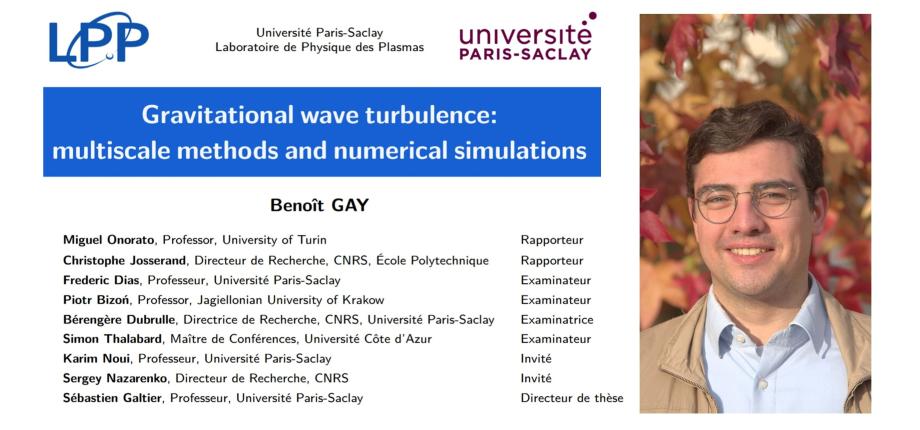
Benoît Gay defended his PhD "Gravitational wave turbulence : multi-scale methods and numerical simulations"
The first direct detection of gravitational waves by the LIGO–VIRGO collaboration [Abbott et al., 2016], made a century after Einstein’s prediction, has opened the door to probing events in the early universe, where many models anticipate the presence of such waves. With their comparatively large amplitudes, these waves can interact in a nonlinear way, offering a new avenue for exploring phenomena arising from general relativity. An analytical theory of weak gravitational wave turbulence [Galtier & Nazarenko, 2017] predicted a dual cascade of energy and wave action that was later borne out through numerical simulations [Galtier & Nazarenko, 2021].
In the first part, the kinetic equation governing gravitational wave turbulence is derived using a multi-time-scale approach. The aim is to clarify the role of the initial conditions and to demonstrate the emergence of an analytical closure for four-wave interactions. Although the resulting equation differs slightly from the Hamiltonian formulation, both yield the same Kolmogorov–Zakharov spectrum. We further demonstrate that the system retains a memory of its initial state up to second order in time.
This analytical study is then complemented by GPU-accelerated pseudo-spectral simulations, which allow for a more detailed examination of the dynamics of the dual cascade. In particular, the simulations confirm the theoretical predictions and also reveal the existence of intermittent and multifractal behaviour for large amplitude events. The metric components likewise exhibit evidence of a dual cascade, while the scalars of general relativity (Ricci and Kretschmann) point towards a physical relevance.
Finally, we turn to the nonlinear diffusion equation derived from the kinetic equation. In the forced regime, we observe a dual cascade consistent with the theoretical Kolmogorov–Zakharov spectra. By contrast, in the decaying case, the wave action spectrum is unexpected: extending beyond the injection scale, leaving only a single inertial range in which the Kolmogorov–Zakharov spectrum gradually develops. Taken together, these studies deepen our understanding of the turbulent behaviour of gravitational waves from both theoretical and numerical standpoints, and represent a step towards a comprehensive theory of gravitational wave turbulence.