





Enceladus: Saturn’s Tiny Moon Sculpts its Environment Over Record Distances
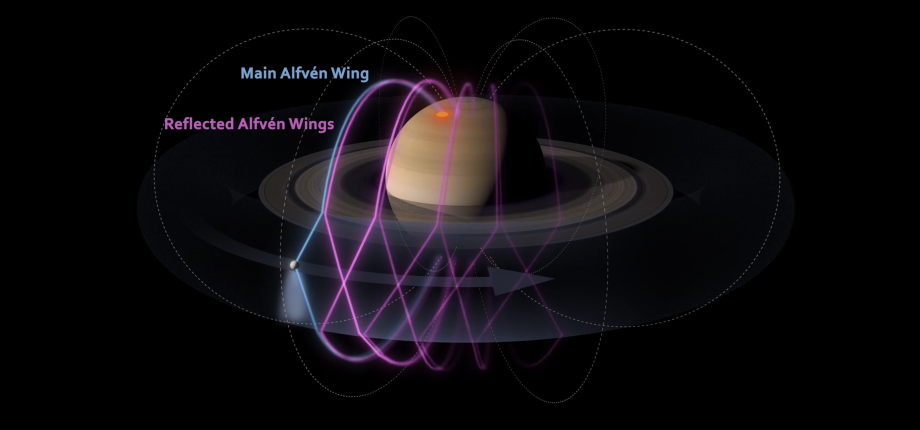
Despite its modest size, Enceladus exerts a colossal electromagnetic influence on Saturn’s environment. An international study led by researchers from the Laboratory of Plasma Physics (LPP) reveals that this moon acts as a giant planetary-scale Alfvén wave generator, extending its wake over more than 500,000 km.
A Record Footprint on a Planetary Scale
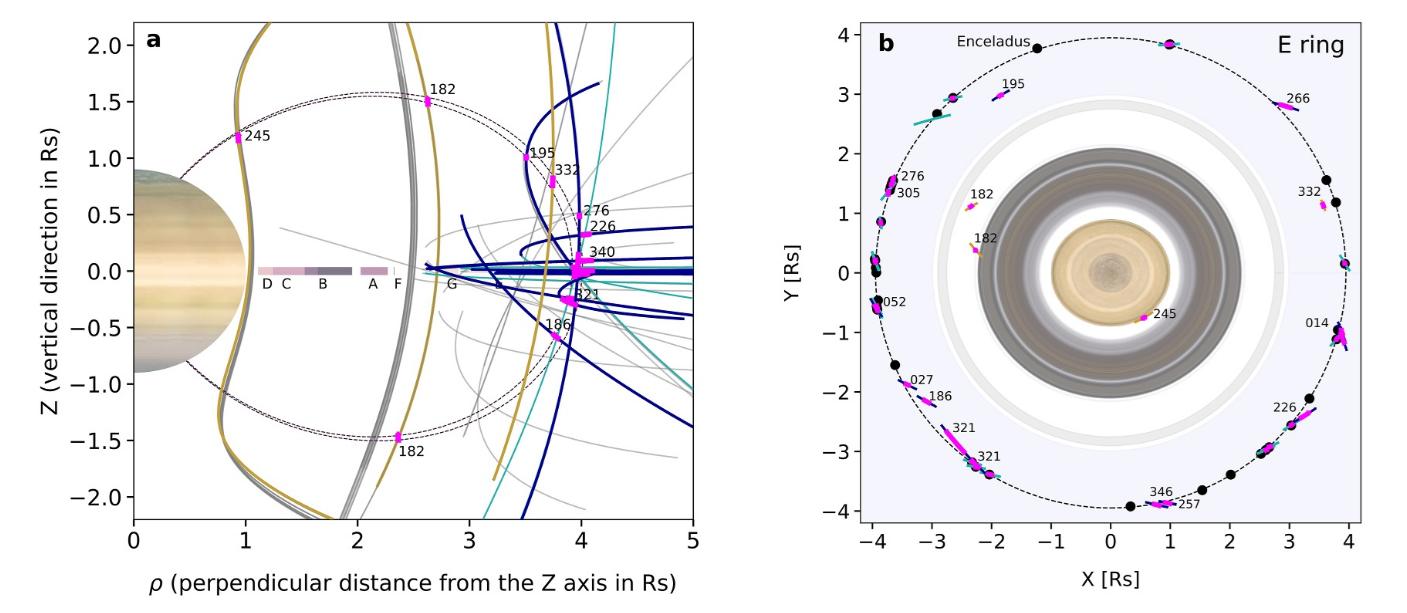
While Enceladus is famous for its water vapor geysers, its driving role within the Saturnian system has been underestimated until now. By analyzing 13 years of archival data from the Cassini mission (NASA/ESA/ASI), a team led by Lina Hadid and Thomas Chust (LPP), in collaboration with researchers from various national labs (IRAP, ISAE-SUPAERO, LATMOS, LAM, and LIRA/Observatoire de Paris) and international institutions IRFU/Sweden, MPS/AGermany, CAS/Tcheque, ESA, APL, UCLA, University of Michigan, Boston and Iowa in the USA, DIAS/Ireland, MSSL/UCL and Imperial College in the UK), has demonstrated, through the analysis of "waves and particles" data, that the moon's electromagnetic influence extends over a record distance, equivalent to more than 2,000 times its own radius.
The process begins at Enceladus’ south pole, where geysers have been observed: water molecules ejected by the plumes become ionized and feed a plasma torus. As Saturn’s co-rotating magnetic field sweeps past the moon, it generates wave structures known as "Alfvén wings." The study, published in the Journal of Geophysical Research: Space Physics, shows that these waves do more than just graze the moon:
- They travel like vibrations on a string along magnetic field lines toward Saturn’s two poles.
- They undergo multiple reflections between Saturn’s ionosphere and the plasma torus surrounding the moon’s orbit.
- This bouncing effect creates a complex network of crisscrossing waves that reach the very high northern and southern latitudes of the giant planet.
A New Vision for Space Exploration
Beyond Saturn, this work lays the foundation for studying other planetary systems, such as the moons of Jupiter (a key objective of the JUICE mission, in which LPP participates by providing the Search-Coil Magnetometer) or even exoplanets. This discovery also highlights the importance of future missions to Enceladus, notably the ESA orbiter and lander project planned for the 2040s, which will require state-of-the-art instrumentation to probe these complex interactions.
Link to the article: click here
Video link: click here