



A new approach to investigate turbulent wave processes in the solar wind
Interactions between energetic electron beams and solar wind plasmas are at the origin of various processes of turbulent waves’ transformations and electromagnetic radiation during solar radio bursts of types II and III. The properties of electrostatic wave turbulence excited by electron beams in randomly inhomogeneous and weakly magnetized solar wind plasmas can be evidenced by studying the statistics of Langmuir and upper-hybrid waves’ electric fields’ amplitudes. This can provide key information on linear and nonlinear processes developing in turbulent plasmas. Nowadays, modern spacecraft such as Solar Orbiter and Parker Solar Probe provide the unique opportunity to study the characteristics of electric field distributions directly using the waveforms measured in the solar wind.
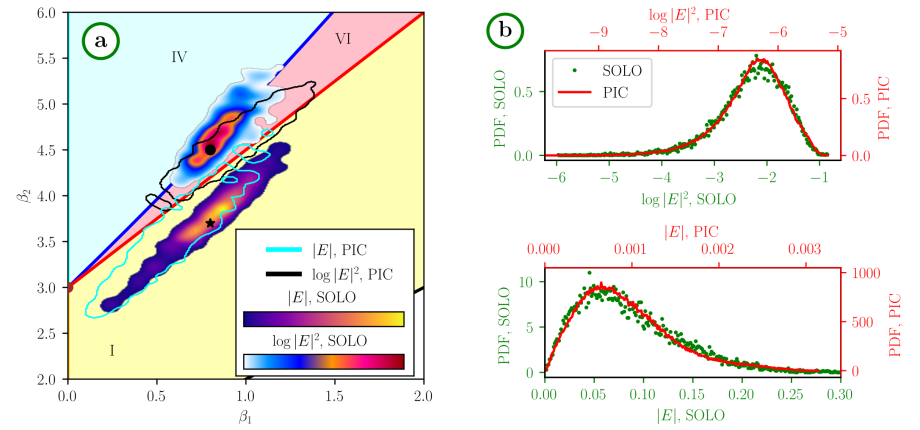
In the present work, we study the statistical properties of beam-driven upper-hybrid wave turbulence in the solar wind by focusing on the probability density functions (PDFs) of electric field amplitudes |E|. For the first time, high-resolution simulations are carried out to analyze correlations between the skewness (degree of anisotropy) and the kurtosis (degree of flatness) of the PDFs of |E| and log|E|², for various intensities of the plasma magnetization ratio Ω=ωc/ωp and average levels of random density fluctuations ΔN. Electric field distributions log |E|² and |E| are shown to be in good agreement with typical distributions obtained from the Time Domain Sampler subunit installed on the Solar Orbiter spacecraft. Results demonstrate the promising potential of this method for investigating wave turbulent processes in plasmas, as well as for detecting and classifying interesting events in satellite datasets.
The figure below illustrates the comparison between the statistical distributions measured by Solar Orbiter and those obtained from simulation. Panel (a) shows the β-distributions of the PDFs of |E| and log|E|², plotted as a function of skewness β₁ and kurtosis β₂, for waveforms recorded by the RPW-TDS receiver onboard Solar Orbiter (January 17, 2023, sampling rate 262 kHz). The simulation results, performed in a weakly magnetized and randomly inhomogeneous plasma (ΔN = 0.025, Ω = 0.01), appear as superimposed contours: black lines correspond to log|E|² and cyan lines to |E|. Panel (b) presents an example of PDFs measured by Solar Orbiter (green points) and calculated by simulation (red lines). The corresponding positions in the (β₁, β₂) plane are indicated in panel (a) by a black dot for log|E|² and a black star for |E|.
We would like to thank the Smilei development team for their code and support, as well as the Solar Orbiter RPW and TDS teams for their observations.
Référence: Statistical properties of beam-driven upper-hybrid wave turbulence in the solar wind. V. Annenkov, C. Krafft, A. Volokitin, P. Savoini, A&A 699 L6 (2025), https://doi.org/10.1051/0004-6361/202555087