




Precipitations of solar wind ions at the surface of the planet Mercury
The Sun constantly emits a stream of charged particles, known as solar wind. Mercury, the planet closest to the Sun, experiences solar winds and storms more than 10 times more powerful than those experienced by Earth, which is located 1 astronomical unit away. Even along its orbit, which is highly elliptical between a perihelion of 0.31 astronomical units from the Sun and an aphelion of 0.47, Mercury is subject to very different solar wind pressures. Finally, against these intense solar winds, the planet offers only a weak magnetic protection due to a dipolar moment about 3,000 times weaker than that of the Earth. As such, its magnetosphere is particularly narrow and solar wind ions can easily impact the planet’s surface. Such interaction leads to sputtering effects, which in turn allows planetary elements to escape from the surface and ultimately determine the composition of the entire Hermean environment.
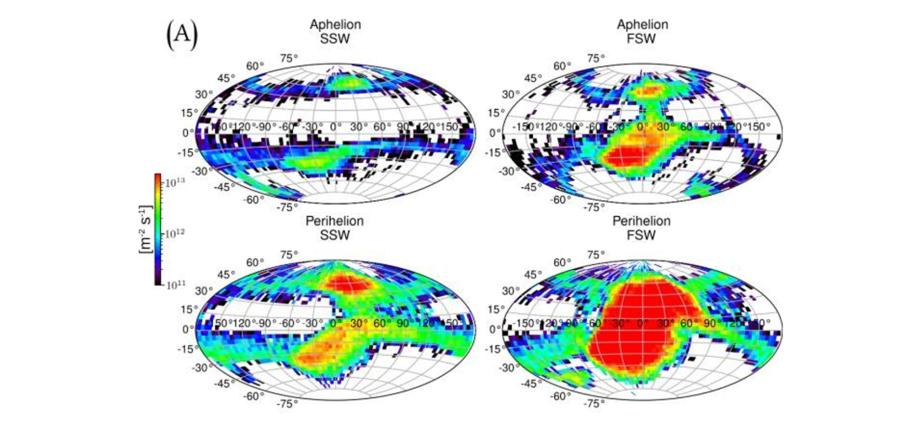
By using hybrid numerical simulations (where ions are treated as particles and electrons as a fluid), we have determined the main regions of the solar wind ion precipitation on the planet’s surface. The figure shows very different precipitation patterns depending on whether the planet is at aphelion (upper row) or perihelion (lower row), embedded in slow (left column) or fast solar winds (right column). The latter resembles the case of a solar storm, during which the solar ion flux can directly impact most of Mercury’s dayside hemisphere (figure at bottom right). In other cases, we have shown the precipitation region in the southern hemisphere is far more developed than that in the northern hempisphere, so that could it have a much greater impact on the Mercury’s dynamics.
These new results are timely for the BepiColombo mission, which is scheduled to explore Hermean environment from the end of 2026.