





Zhan Shu defended his PhD "Absolute calibration and quantification of atomic oxygen in nanosecond plasmas using two-photon absorption laser-induced fluorescence"
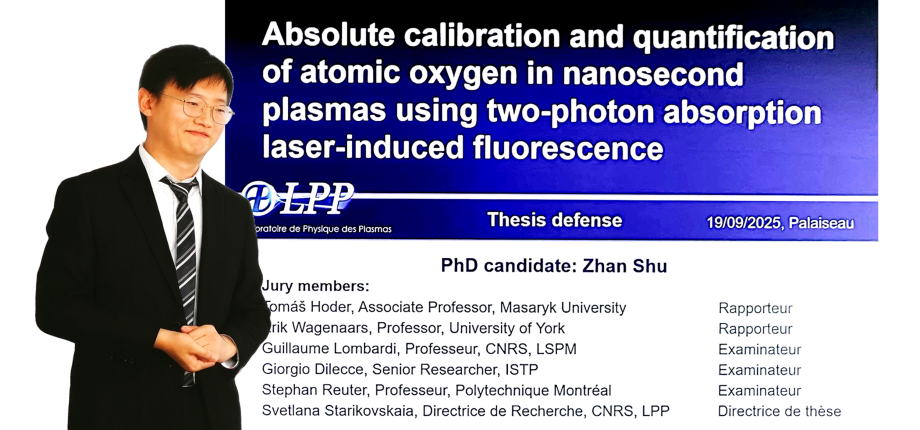
Zhan Shu defended his PhD "Absolute calibration and quantification of atomic oxygen in nanosecond plasmas using two-photon absorption laser-induced fluorescence"
On September 19, 2025, Zhan Shu defended his PhD "Absolute calibration and quantification of atomic oxygen in nanosecond plasmas using two-photon absorption laser-induced fluorescence".
Abstract :
Atomic oxygen is commonly generated in reactive media, such as low-temperature plasmas and combustion environment. Owing to its high chemical reactivity and consequent short lifetime, time- and space-resolved measurements of O-atom density are essential for elucidating particle kinetic behavior and reaction mechanisms. Two-photon absorption laser-induced fluorescence (TALIF) has emerged as a powerful non-intrusive technique for detecting atomic species. By employing fast (nanosecond) and ultra-fast (picosecond or femtosecond) laser pulses, this technique enables the excitation of ground-state atoms and the detection of their subsequent fluorescence, offering excellent temporal and spatial resolution. When properly calibrated, TALIF allows absolute quantification over a dynamic range.
A significant challenge in the calibration of O-TALIF lies in the uncertainty associated with the two-photon absorption cross-section ratio between the reference gas xenon and atomic oxygen. This ratio was determined by only one group of authors and has been widely used for twenty years. However, recent studies have indicated that this value may lead to an overestimation of the atomic oxygen density. Another issue happens when applying ultra-fast TALIF, which is especially well-suited for diagnosing transient plasmas characterized by strong collisional quenching at high pressures. Under conditions of high laser power density, the rate-equation-based model may overestimate the excited-state population, and thus the inferred ground-state density, due to the omission of coherence effects and saturation phenomena.
This thesis proposed a novel approach to calibrate the two-photon absorption cross-section ratio of Xe/O in nanosecond TALIF application. A nanosecond pulsed discharge, applied within a millimeter-scale capillary tube, enables efficient molecular dissociation at high reduced electric field and high specific deposited energy. Notably, complete dissociation of molecular oxygen was achieved in the afterglow of a N2 + 5%/2% O2 discharge at moderate pressure, providing a practical and well-characterized source of atomic oxygen. Then the known density served as a robust calibration reference for the Xe/O cross-section ratio. A developed one-dimensional numerical simulation was used to verify the 100% oxygen disso-ciation, compare with the experimental data, and analyze the formation pathways of atomic oxygen. Electrical diagnostics were employed by back-current shunt and capacitive probe techniques, while gas temperature was determined using optical emission spectroscopy. These measurements helped to characterize and customize the discharge, forming the basis for kinetic modeling and the validation of calculation results.
The calibration work of Xe/O cross-section ratio was subsequently extended to picosecond TALIF measurements. Compared to nanosecond TALIF, the picosecond pulsed laser offers a more efficient excitation of ground-state oxygen atoms. The Xe/O cross-section ratio was confirmed to be 1.8 for both nanosecond and picosecond regimes, with uncertainties of ±0.2 and ±0.3, respectively. The validity range of the rate equations and the conditions under which a transition to the optical Bloch equations becomes necessary were discussed.
Further applications of O-TALIF were explored, emphasizing its capability for time- and space-resolved diagnostics. The temporal evolution of atomic oxygen in the afterglow of nanosecond capillary discharges in CO2 was measured to validate the kinetic model and provide insights into the dissociation pathways at high reduced electric field and high specific deposited energy. The implementation of absolute calibration in the nanosecond varying-gap plane-to-plane discharge confirmed the formation of an O-atom density gradient, which may play a critical role in the initiation and propagation of detonation waves.
Jury :
Tomáš Hoder, Associate Professor, Masaryk University — Rapporteur
Erik Wagenaars, Professor, University of York — Rapporteur
Guillaume Lombardi, Professeur, CNRS, LSPM — Examinateur
Giorgio Dilecce, Senior Researcher, ISTP — Examinateur
Stephan Reuter, Professeur, Polytechnique Montréal — Examinateur
Svetlana Starikovskaia, Directrice de Recherche, CNRS, LPP — Directrice de thèse