





Anatole Berger defended his PhD "On the use of moment methods for modeling low-temperature plasmas in the low and intermediate pressure regime"
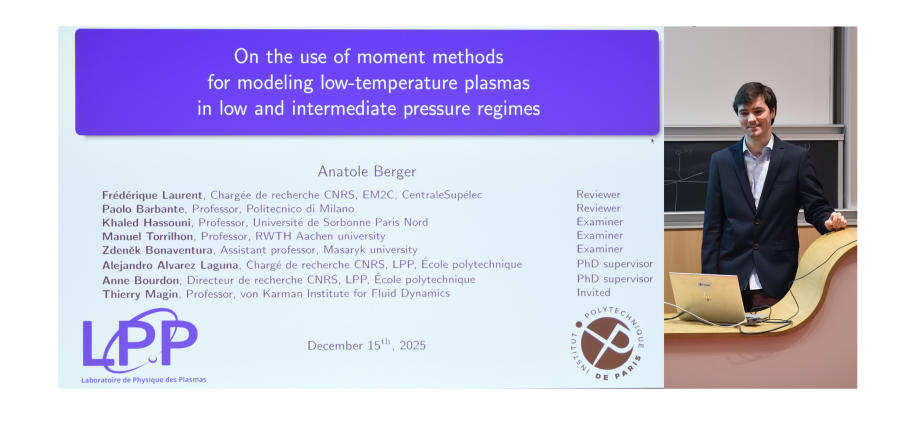
Congratulations to Anatole Berger who successfully defended his PhD "On the use of moment methods for modeling low-temperature plasmas in the low and intermediate pressure regime" on December 2025.
Summary :
Low-temperature plasmas are used in many technological applications, from microelectronics manufacturing to electric space propulsion. They exhibit strong nonequilibrium features that cannot be described by classical fluid models, and require kinetic models, that are often computationally much more expensive.
This thesis investigates the method of moments as an intermediate approach between fluid and kinetic descriptions for low-temperature plasma modeling. This method is based on a hierarchy of equations derived from the kinetic theory, that must be closed to truncate the system. %With appropriate closures, it can capture nonequilibrium effects at a computational cost close to that of fluid models.
For ions, several 1D five-moment models are considered, including the regularized Grad method, a maximum-entropy approach, and two Gaussian quadrature models (HyQMOM and EQMOM). These models are implemented in numerical simulations with second-order finite-volume schemes, and benchmarked against kinetic simulations, for one-dimensional bounded plasma in a wide range of pressures. The results show that five-moment models achieve significantly better accuracy than fluid models while maintaining similar numerical efficiency. HyQMOM proves particularly robust across all tested conditions, accurately reconstructing velocity distribution functions in both plasma bulk and sheath regions.
Realistic ion–neutral collisions, including isotropic scattering and charge exchange, are then introduced using real argon cross-section data. In particular, we developed a particular collision model for HyQMOM, further improving results fidelity.
Finally, electron dynamics is studied using an isotropic moment formulation based on the spherical harmonics expansion. Implemented in a 0D simulation, this modeling effectively represent non-Maxwellian features, especially the ionization.
Overall, the method of moments was shown to be a promising and efficient alternative to kinetic models to describe weakly-ionized low-temperature plasma, capable of capturing nonequilibrium effects with reduced computational cost.
Jury :
Khaled Hassouni, professeur des universités at Université de Sorbonne Paris Nord : president of the jury
Frédérique Laurent, chargée de recherche CNRS at EM2C, CentraleSupélec : reviewer
Paolo Barbante, associate professor at Politecnico di Milano : reviewer
Manuel Torrilhon, professor at RWTH Aachen university : examiner
Zdenek Bonaventura, assistant professor at Masaryk university : examiner
Alejandro Alvarez Laguna, chargé de Recherche CNRS at LPP, École polytechnique : PhD supervisor
Anne Bourdon, directrice de Recherche CNRS at LPP, École polytechnique : PhD co-supervisor
Thierry Magin, professor at von Karman Institute for Fluid Dynamics : invited