




Exploring the link between edge flows and the good confinement of tokamak plasmas with negative triangularity
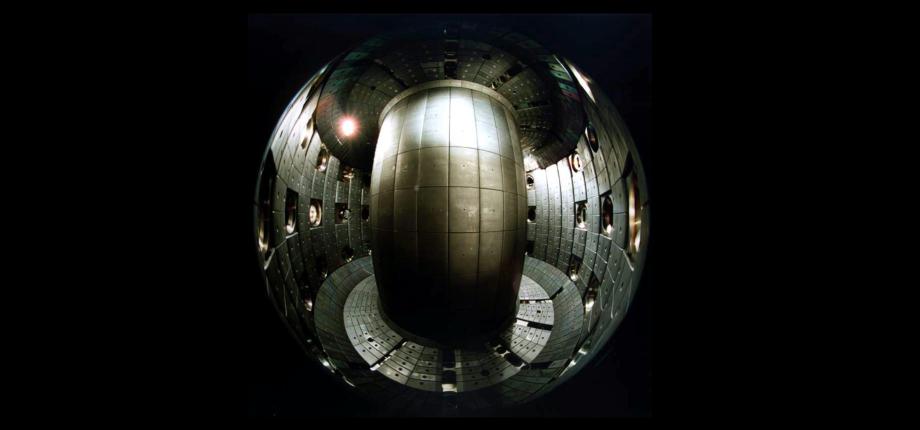
The cross-section of tokamak plasmas is usually non-circular; the plasma column tends to be vertically elongated and "D"-shaped. The shaping parameter that characterizes the "D"-ness is called triangularity. In recent years, the exotic negative triangularity (NT) shape has attracted renewed interest in the fusion community. NT corresponds to a cross-section resembling a flipped "D" (Figure 1).
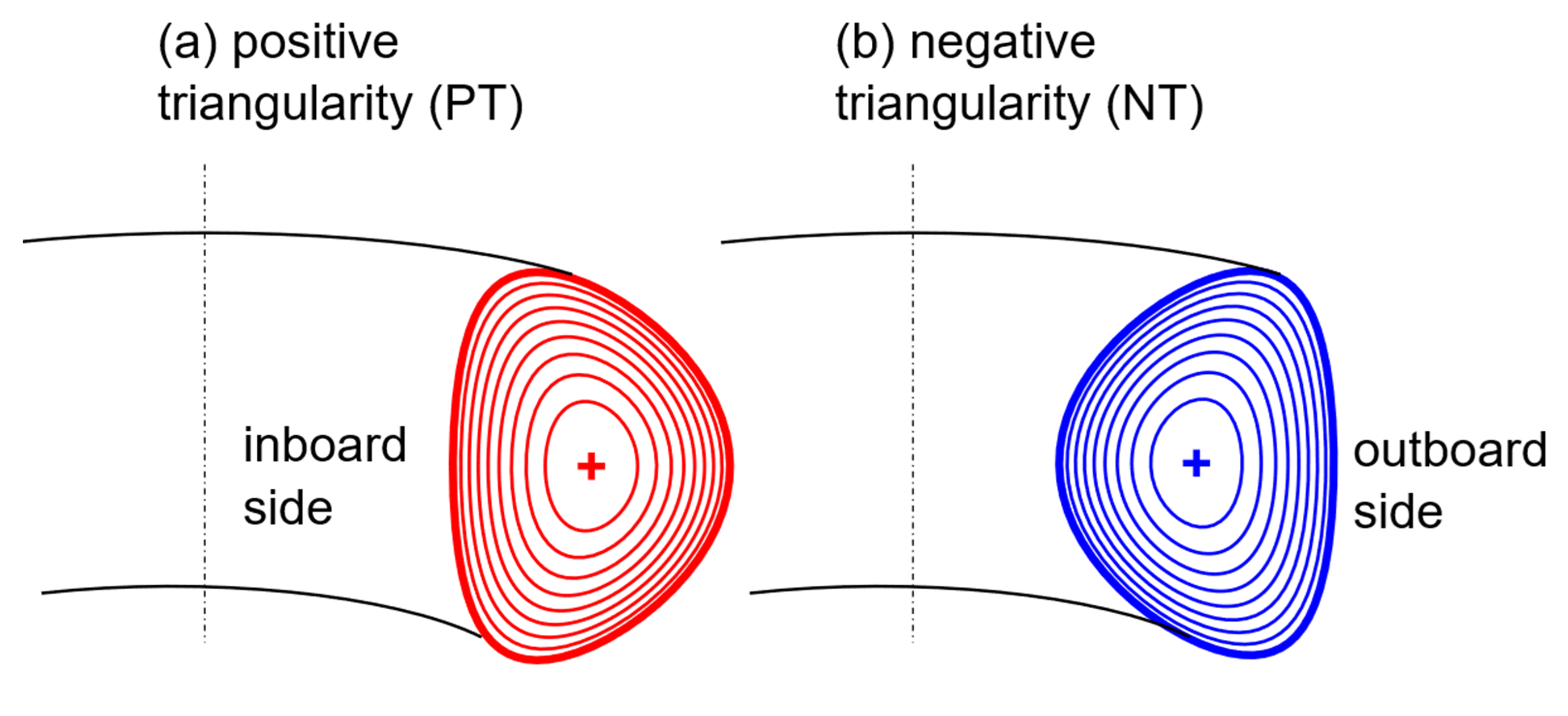
Figure 1: Sketch of tokamak plasma cross-sections with (a) positive and (b) negative triangularity
NT plasmas can achieve confinement performances similar to the high confinement (H-mode) regime of their PT counterparts, while remaining in a confinement regime that is decisively more benign for the operation of future reactors [1-2]. Indeed, the large temperature and density gradients reached in standard H-mode trigger recurrent edge MHD instabilities (so-called edge-localized modes, or ELMs). These ELMs expel large amounts of thermal energy, thereby causing high transient heat loads on the device walls that will not be tolerable in a reactor. With the intrinsic avoidance of ELMs combined with good confinement, NT appears to be a suitable candidate scenario that could reconcile high fusion performance with power-handling demands.
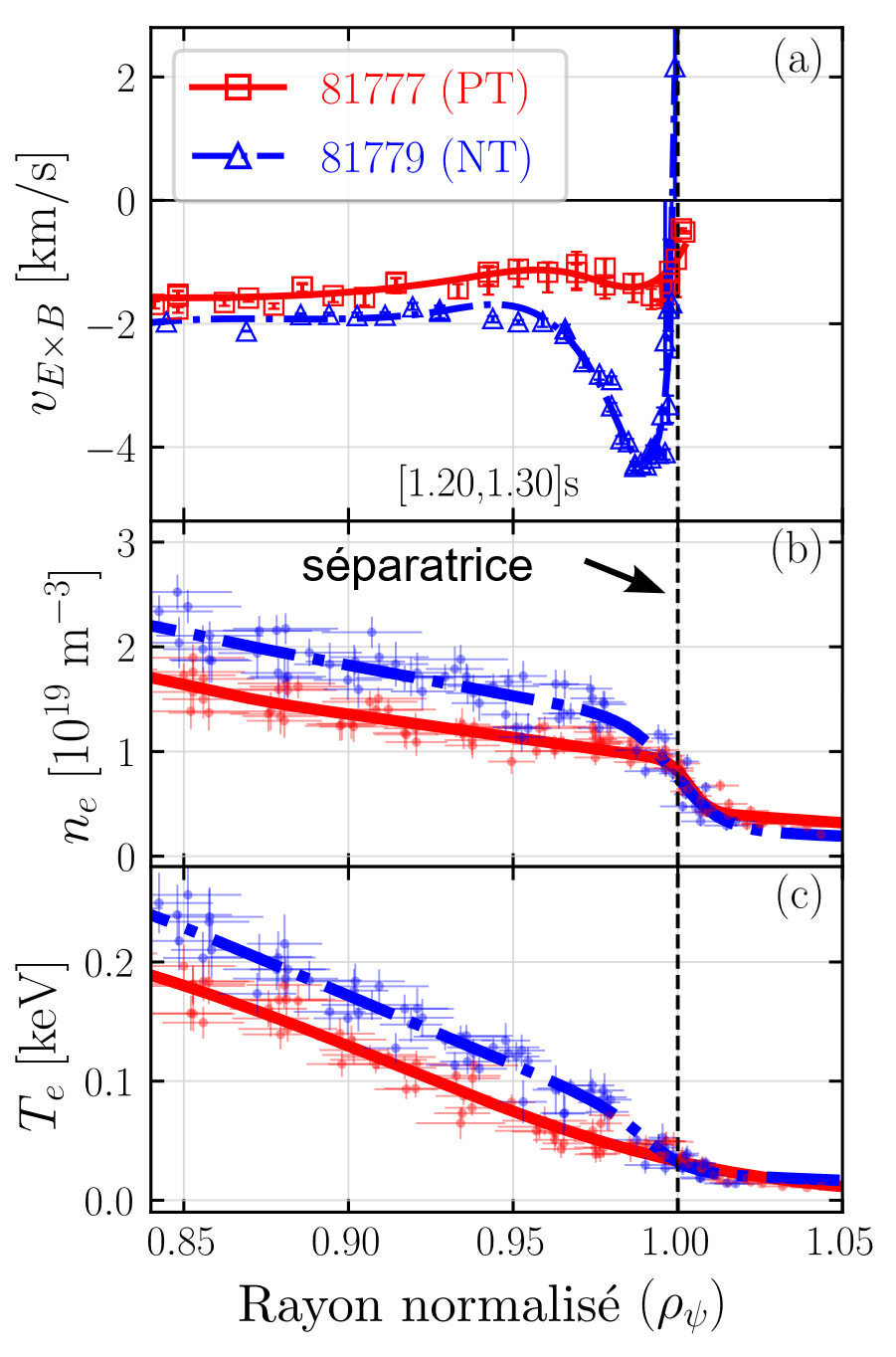
Thanks to the LPP Doppler backscattering diagnostic installed in 2023 on the Swiss TCV tokamak [4], we obtained, for the first time, detailed comparisons of the radial profile of the ExB rotation velocity (v_(E×B )) between carefully matched NT and PT plasmas [3]. The characteristic well-like shape of v_(E×B ) that usually develops just inside the boundary is clearly more pronounced in NT (Figure 2a), resulting in strongly sheared ExB flows at the plasma edge in the NT configuration. Various scans in the external heating power or density show that this NT/PT difference is robust. Combined with analyses of other edge profiles, including plasma density and temperature (Figure 2 c,d), as well as turbulent fluctuation levels, the results align with the widespread hypothesis of a reduced turbulent transport in NT relative to PT.
Our observations suggest that the stabilizing effect of NT on turbulence may be caused or promoted by stronger edge flow shear. The origin of the different edge v_(E×B ) behavior in NT is being investigated using first-principles plasma turbulence codes.
This study was made possible through a collaboration between LPP and EPFL's Swiss Plasma Center (SPC) in Lausanne.
the article can be downloaded by clicking here.
[1] S. Coda et al 2022 Plasma Phys. Control. Fusion 64 014004
[2] A. O. Nelson et al 2023 Phys. Rev. Lett. 131, 195101
[3] S. Rienäcker et al 2026 Nucl. Fusion 66 014002
[4] S. Rienäcker et al 2025 Plasma Phys. Control. Fusion 67 065003
Contacts: S. Rienäcker, P. Hennequin, L. Vermare
Figure 2: Radial profiles across the plasma edge region of matched PT and NT discharges in the TCV tokamak: (a) ExB velocity, (b) electron density, and (c) electron temperature.