





Plasma-Assisted Combustion: a Two-Part Reference Review to Understand Fundamentals and Applications
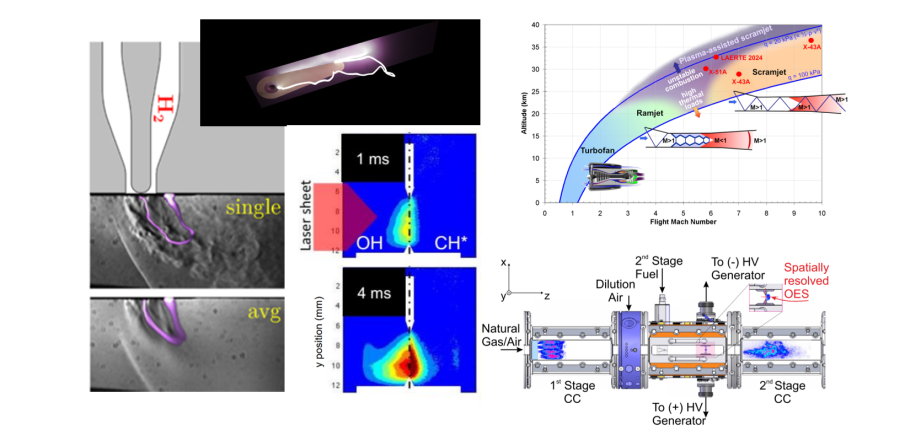
In their two-part tutorial review published in Plasma Sources Science and Technology, Svetlana Starikovskaia, Victor Lafaurie, Jean-Baptiste Perrin-Terrin (EM2C), and Christophe Laux (EM2C) present a comprehensive overview of plasma-assisted combustion (PAC). The review is explicitly structured to guide readers from fundamental combustion and plasma physics to the mechanisms and practical applications relevant to modern energy and propulsion systems.
Part 1 entitled Fundamentals of Combustion and Plasma [download here] establishes the scientific baseline needed to understand PAC. It begins with a review of classical combustion theory, including chemical kinetics, flame structure, ignition, stability, and pollutant formation. The text then introduces plasma physics at a level tailored for combustion researchers, explaining key plasma types (thermal vs. non-thermal), discharge methods, and energy coupling mechanisms. A central theme is how non-equilibrium plasmas can selectively excite electrons, generate radicals, and promote chemical reactions without significantly increasing gas temperature. By bridging combustion chemistry and plasma physics, Part 1 clarifies why plasmas are uniquely effective for ignition enhancement, flame stabilization, and kinetic control, especially under lean, low-temperature, or high-speed flow conditions.
Part 2 entitled Mechanisms and Applications [download here] builds directly on this foundation, focusing on how plasma interacts with reacting flows and how these interactions are exploited in practice. It details the dominant PAC mechanisms, such as enhanced radical production, accelerated chain-branching reactions, vibrational excitation, and improved mixing effects. The document emphasizes the multi-scale nature of PAC, spanning nanosecond electron dynamics to macroscopic flame behavior. It then surveys experimental diagnostics, modeling approaches, and numerical challenges associated with plasma–combustion coupling. The latter sections expand into applications, including gas turbines, scramjets, internal combustion engines, and low-emission burners, highlighting both demonstrated benefits and current limitations such as efficiency, durability, and scalability.
Taken together, the two parts offer a structured, end-to-end treatment of plasma-assisted combustion—from first principles through mechanisms to engineering implementation.
Pris ensemble, les deux volets offrent une présentation structurée et cohérente de la combustion assistée par plasma, allant des principes fondamentaux aux mécanismes physiques et chimiques, jusqu’à l’implémentation dans des systèmes d’ingénierie réels.
Contacts:
Svetlana STARIKOVSKAIA: svetlana.starikovskaia@lpp.polytechnique.fr
Victor LAFAURIE: victor.lafaurie@cares.cam.ac.uk