





Analysis of Twenty Years of Measurements from Four Missions Validates Magnetic Reconnection Models
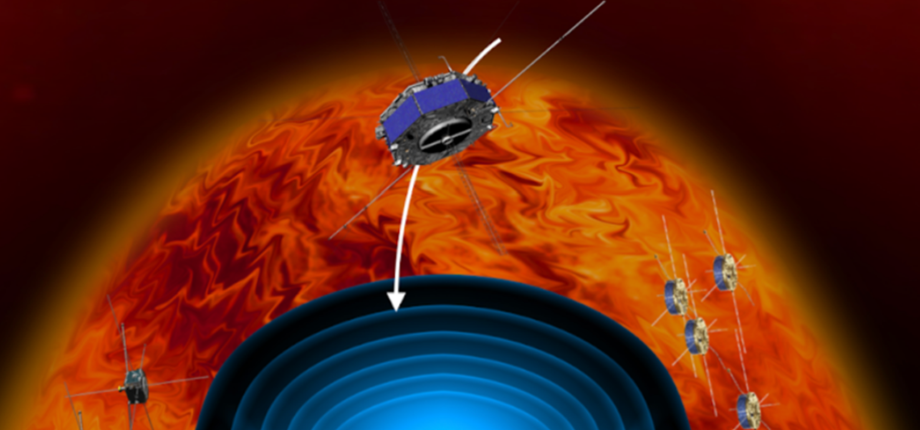
By allowing plasmas to exchange their magnetic connectivity, the process of magnetic reconnection enables the sudden release of magnetic energy in the form of accelerated particles and fast, heated flows. For more than half a century, reconnection has been suspected to play a central role in scenarios explaining intense energetic events throughout the universe, from the solar corona to stellar coronae and accretion disks, and from planetary magnetospheres to those of black holes and neutron stars. To account for these violent events, reconnection must be sufficiently fast—a requirement that numerical models have predicted for the past 30 years, but that observational measurements have struggled to confirm. This crucial measurement has now been achieved by Bayane Michotte de Welle, a postdoctoral researcher at NASA, and her team, composed of scientists from LPP, LAB, IRAP, ONERA and NASA. Their result is based on the analysis of 20 years of in situ data collected by four different missions in Earth’s magnetosphere, using machine learning techniques.
Because of its relative proximity, Earth’s magnetosphere provides an exceptional natural laboratory in which plasma processes can be studied through in situ measurements of plasma properties and magnetic fields by satellites. Magnetic reconnection plays a key role there: it connects the interplanetary magnetic field to the geomagnetic field, allowing the solar wind plasma to enter the otherwise confined magnetospheric cavity. The reconnection rate at the magnetopause—the boundary separating the solar wind from the magnetosphere—can be estimated as the ratio between the component of the magnetic field normal to this boundary and the component tangential to it. The main challenge lies in measuring the normal component, which is typically affected by large uncertainties associated with surface waves propagating along the magnetopause.
This is where the team took advantage of the vast volume of data accumulated over decades, betting that, on average, these fluctuations would cancel out, allowing the signal to emerge from the noise. Training a machine-learning algorithm to accurately predict the satellite’s relative position with respect to the magnetopause enabled the extraction of more than one million measurements taken in the vicinity of, and on both sides of, the magnetopause. The bet paid off when the normal component emerged unambiguously from the noise, making it possible to confirm numerical predictions for the value of the reconnection rate.
These observational results, whose impact extends well beyond magnetospheric physics alone, highlight the importance of exploring our space environment to understand fundamental physical processes. They also illustrate the growing role of machine-learning algorithms in the future exploitation of the treasure trove represented by the large volumes of data collected in this environment over past decades, as well as by future missions planned by the community.
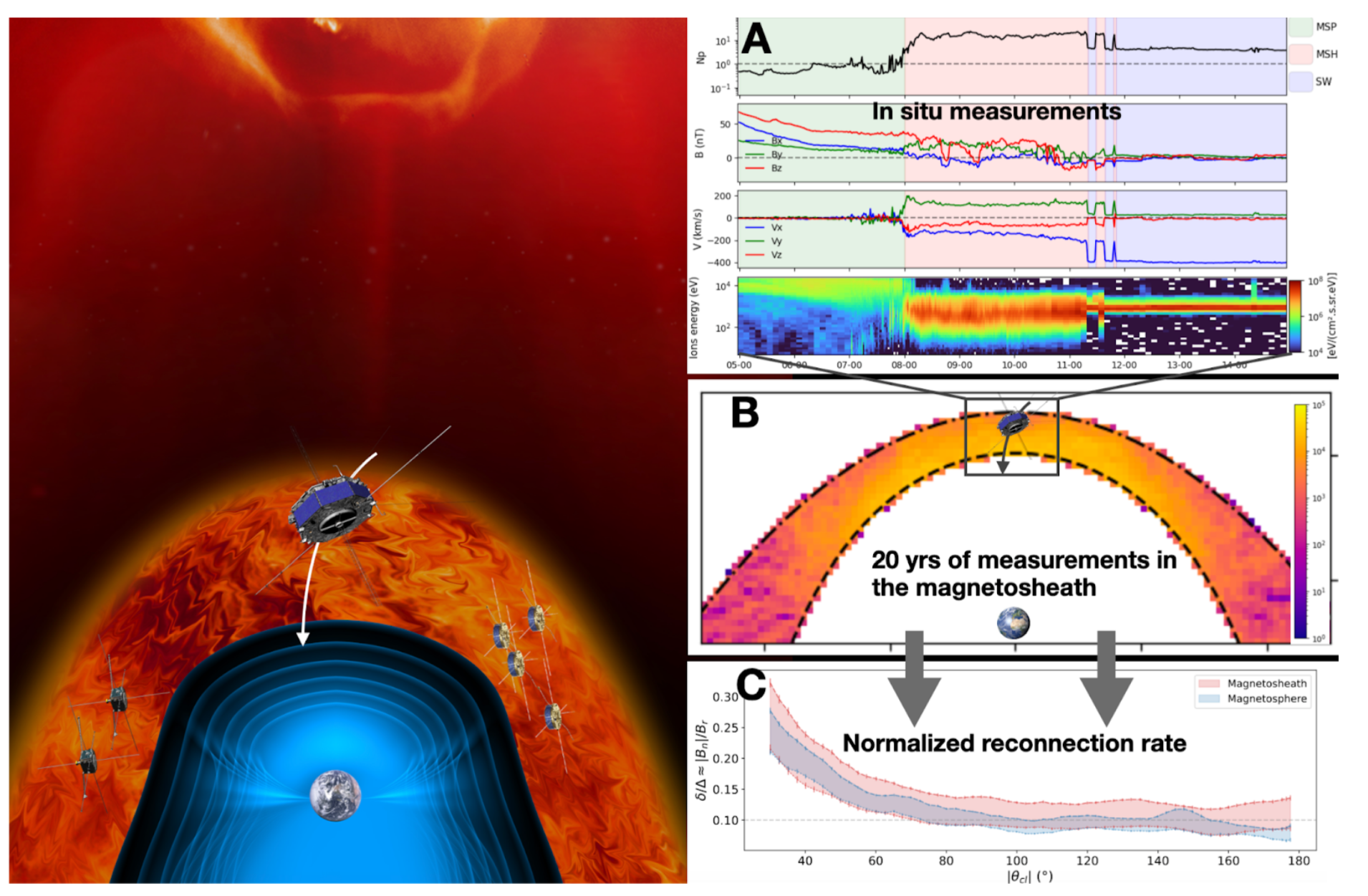
In situ measurements (A) from 4 satellite missions obtained during 20 year on the dayside of the Earth’s magnetosphere (B) analyzed by machine learning algorithms confirm magnetic reconnection theory (C). Crédits: ESA (https://sci.esa.int/s/89z7QnA), Michotte de Welle PhD thesis, Michotte de Welle et al. 2026 https://doi.org/10.1029/2025GL119118
- Contact(s) :
- Nicolas Aunai, nicolas.aunai@lpp.polytechnique.fr (CNRS, Laboratoire de Physique des Plasmas)
- Au LPP : Nicolas Aunai, Alexis Jeandet, Ambre Ghisalberti
- Download article: click here.