




Plasma physics

Plasma: A distinct state of matter
Plasma is often considered the fourth state of matter, alongside solid, liquid, and gaseous states. It is a partially or fully ionized gas containing a significant proportion of charged particles (ions and electrons) that can respond to electric and magnetic fields, unlike neutral gases.
These electromagnetic interactions give rise to characteristic collective behaviors, often on large scales, involving fluctuations, oscillations, and dynamic instabilities. The immense diversity of plasmas results from several parameters: the nature of the species present, the degree of ionization, particle energy, electron temperature, and the magnetic environment.
Although rare under natural terrestrial conditions, plasma makes up more than 99% of the visible universe. It can nonetheless be created and controlled on Earth, opening the way to numerous scientific, technological, and industrial applications.
A classification of plasmas
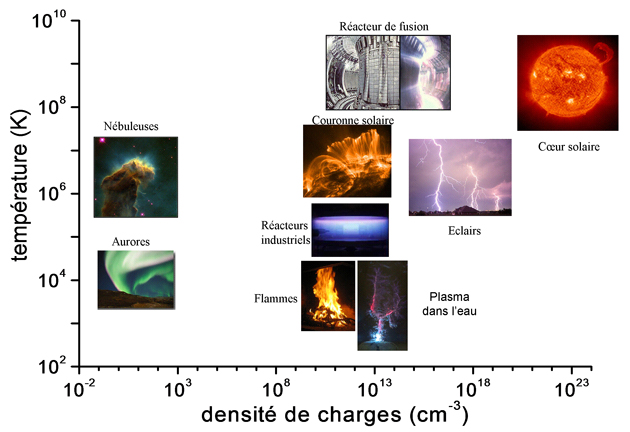
Plasmas can be represented in an electron density–temperature diagram, highlighting the wide range of domains explored:
Natural plasmas: astrospheres, solar wind, planetary magnetospheres, etc.
Laboratory plasmas: cold plasmas for industrial processes, fusion plasmas, Z-pinches, etc.
Non-equilibrium plasmas: very hot electrons in weakly ionized media, etc.
Such a diagram illustrates plasma classification according to their energy (characterized by electron temperature) and charged particle density.
Space plasmas
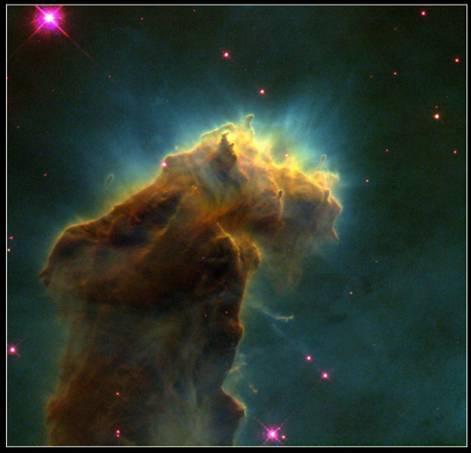
Plasma is ubiquitous in space: the Sun, interplanetary medium, magnetospheres, ionospheres, comets, stars, nebulae, etc. Above about 100 km in altitude, nearly all visible matter is in the plasma state.
Extremely low densities, but very high temperatures
Partially or fully ionized media
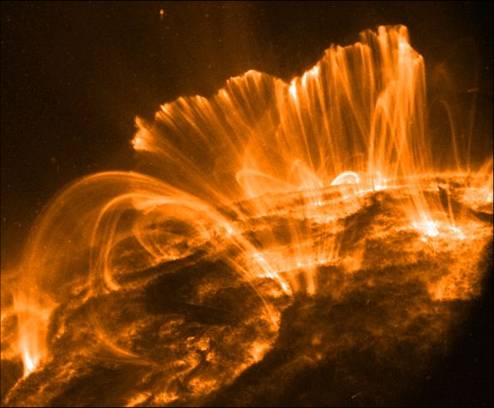
Structuring magnetic fields: confinement, guiding, magnetic reconnection
A remarkable property of space plasmas is their ability to form sharp interfaces between media of different natures, generating phenomena such as:
Astrophysical-scale electric fields
Large-scale electric currents
Magnetic instabilities
Focus on the solar wind
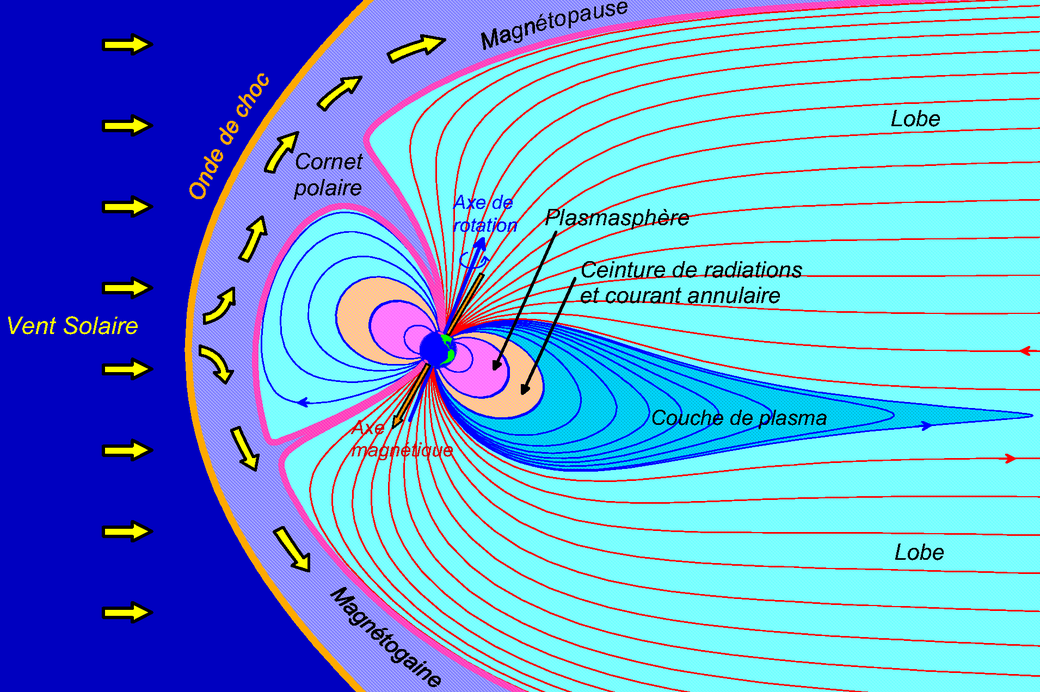
The solar wind, composed mainly of protons and electrons, is a supersonic plasma ejected by the Sun at nearly 500 km/s. It carries the solar magnetic field into interplanetary space.
When interacting with Earth’s magnetosphere, it generates:
A bow shock,
A dayside compression,
A long magnetic tail on the nightside,
A complex plasma distribution in various regions (plasmasheet, lobes, radiation belts, etc.).
This dynamic coupling gives rise to spectacular phenomena: auroras, magnetic storms, particle acceleration, and more.
Cold plasmas
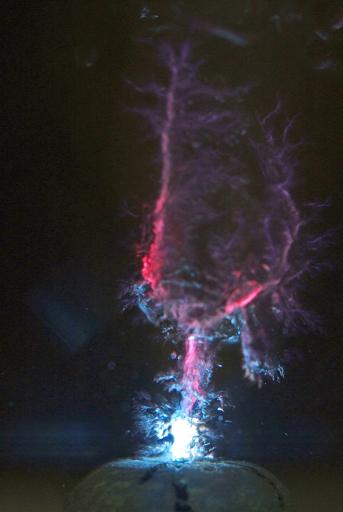
Cold plasmas are thermodynamically non-equilibrium media:
Ions and neutrals: 100 – 1,000 K
Electrons: up to 10⁴ – 10⁵ K
This energy asymmetry enables the efficient generation of reactive species (ions, radicals), which are used for:
Sterilization and decontamination (air, water, surfaces),
Industrial processes (deposition, etching, surface treatments),
Low-pressure space propulsion.
Cold plasmas combine strong application potential with complex physics, making them a highly interdisciplinary and technologically valuable research field.
Fusion plasmas
A major challenge in contemporary plasma physics is to reproduce on Earth the thermonuclear reactions that power the stars, with the goal of producing clean, safe, and virtually inexhaustible energy.
Deuterium–tritium reaction: ²D + ³T → ⁴He + n + 17.6 MeV
Lawson criterion: For a fusion plasma to be self-sustaining, the following condition must be satisfied: n × T × τₑ > 5 × 10²¹ keV·s/m³
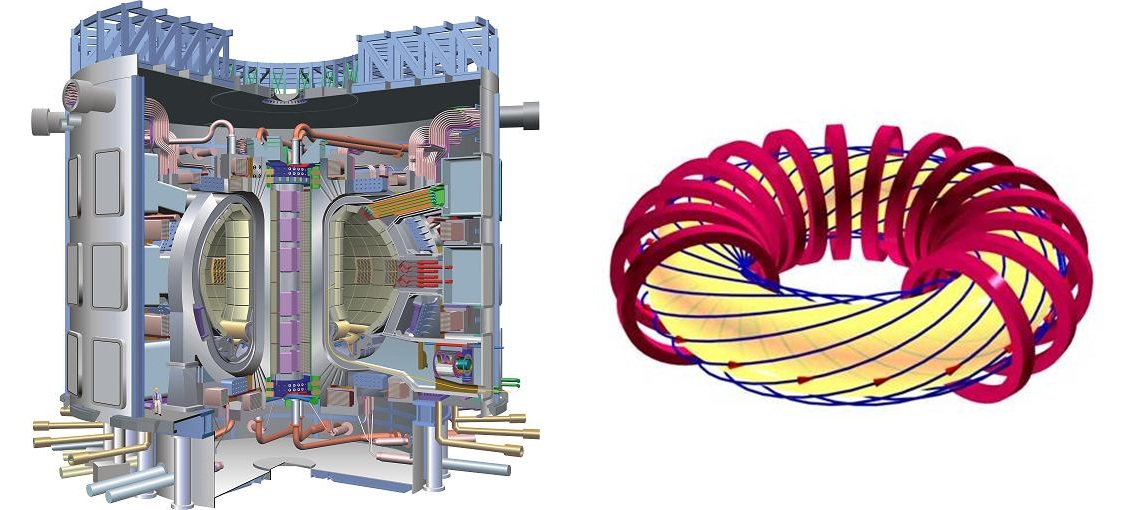
The ITER project: the first tokamak-based reactor designed to meet this criterion. The plasma is magnetically confined at 150 million kelvin. Significant challenges remain:
Control of confinement and turbulence,
Tritium production,
Development of materials resistant to fast neutrons.