




Low Temperature Plasma Team
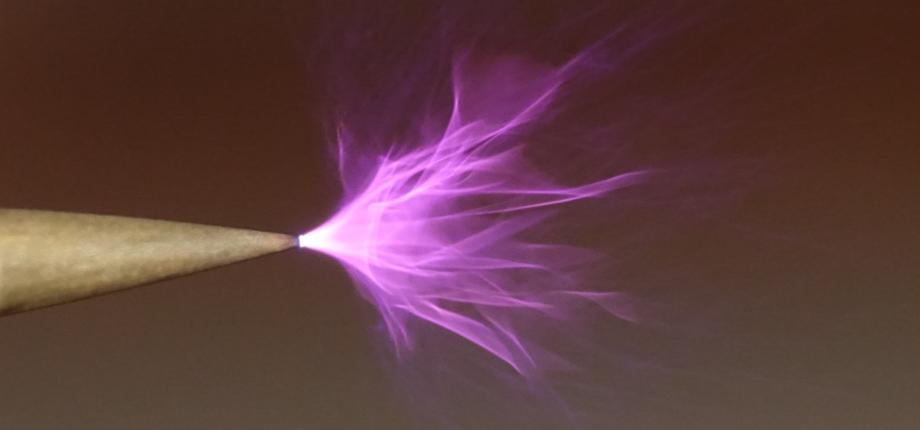
Low-temperature plasmas are used in a wide range of industrial fields, from nanotechnology to environmental applications and aerospace. The team’s activities, both experimental and theoretical, aim to understand the fundamental mechanisms and promote technology transfer.
Cold plasmas (more precisely low-temperature plasmas or non-thermal plasmas) refer to partially ionized gases in which the different particle populations are not at the same temperature.
Typically, electrons have a high electron temperature (often equivalent to several electronvolts, corresponding to energies of tens of thousands of kelvin in “equivalent” temperature), while ions and neutral species remain close to room temperature, although the gas may locally heat up to a few hundred kelvin depending on the discharge regime.
This temperature decoupling is explained by the large mass difference between electrons and heavy particles: during collisions, electrons transfer little kinetic energy to ions and neutrals. However, their energy is sufficient to efficiently trigger inelastic processes (excitation, ionization, dissociation). The system is therefore far from local thermodynamic equilibrium, or more simply, in a non-thermal state.
Two major mechanisms arise from this and structure the specific physico-chemistry of low-temperature plasmas:
Ion dynamics and surface interaction. Under the action of electric fields, positive ions are accelerated, particularly through boundary layers near walls (sheaths). Their impact can induce sputtering, modify the surface (cleaning, activation, roughening), and/or promote heterogeneous reactions, depending on ion energy, material nature, and local chemistry.
Production of reactive species through electron–neutral collisions. Energetic electrons transfer their energy to neutral molecules via inelastic collisions leading to dissociation, electronic/vibrational/rotational excitation, and the formation of short-lived or metastable species. These pathways sustain a non-equilibrium chemistry, generating radicals, ions, and excited species that are crucial for gas-phase and plasma–surface reactions.
Taken separately or synergistically, these mechanisms generate a wide variety of physico-chemical processes in the plasma volume and on exposed surfaces, at the origin of many applications (surface treatment, deposition/etching, chemical conversion, etc.).
The Cold Plasma Team studies the physico-chemistry of these non-equilibrium media, from fundamental aspects of atomic and molecular physics to transfer toward devices and processes. This research combines (i) experimental work based on diagnostics, notably optical techniques, and (ii) theoretical approaches, with a significant part devoted to advanced numerical simulations. The close articulation between theory and experiment is a structuring axis, enabling the study of key questions such as electromagnetic field–plasma coupling, particle transport and acceleration, non-equilibrium chemical reactivity, plasma–surface interaction mechanisms, and plasma–flow coupling (plasma–flux), which are crucial for many applications.
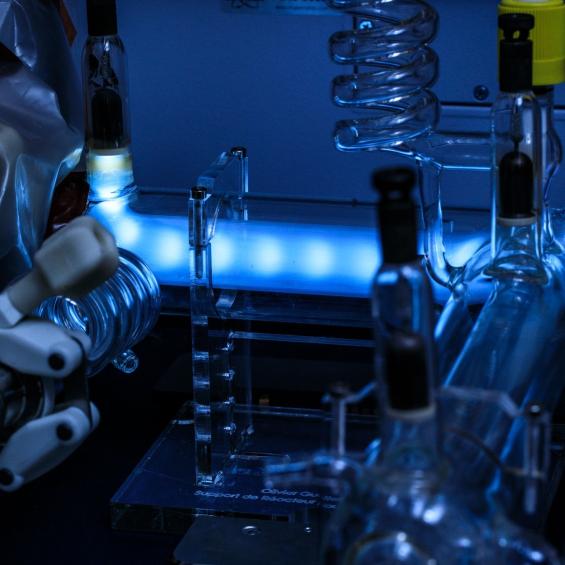
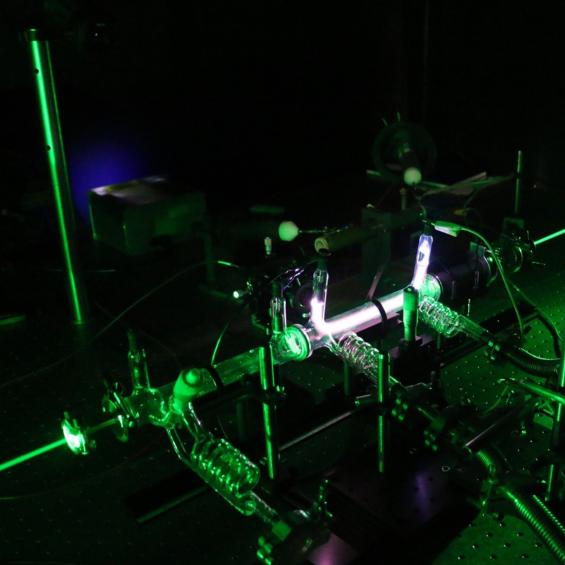
In the laboratory, these plasmas are generally produced by supplying electromagnetic energy (RF, microwave, pulsed discharges, etc.) into reactors containing a gas or gas mixture. Control of external parameters (pressure, gas composition and flow rate, reactor geometry, and power supply characteristics) allows exploration of a wide range of discharge regimes and model systems.
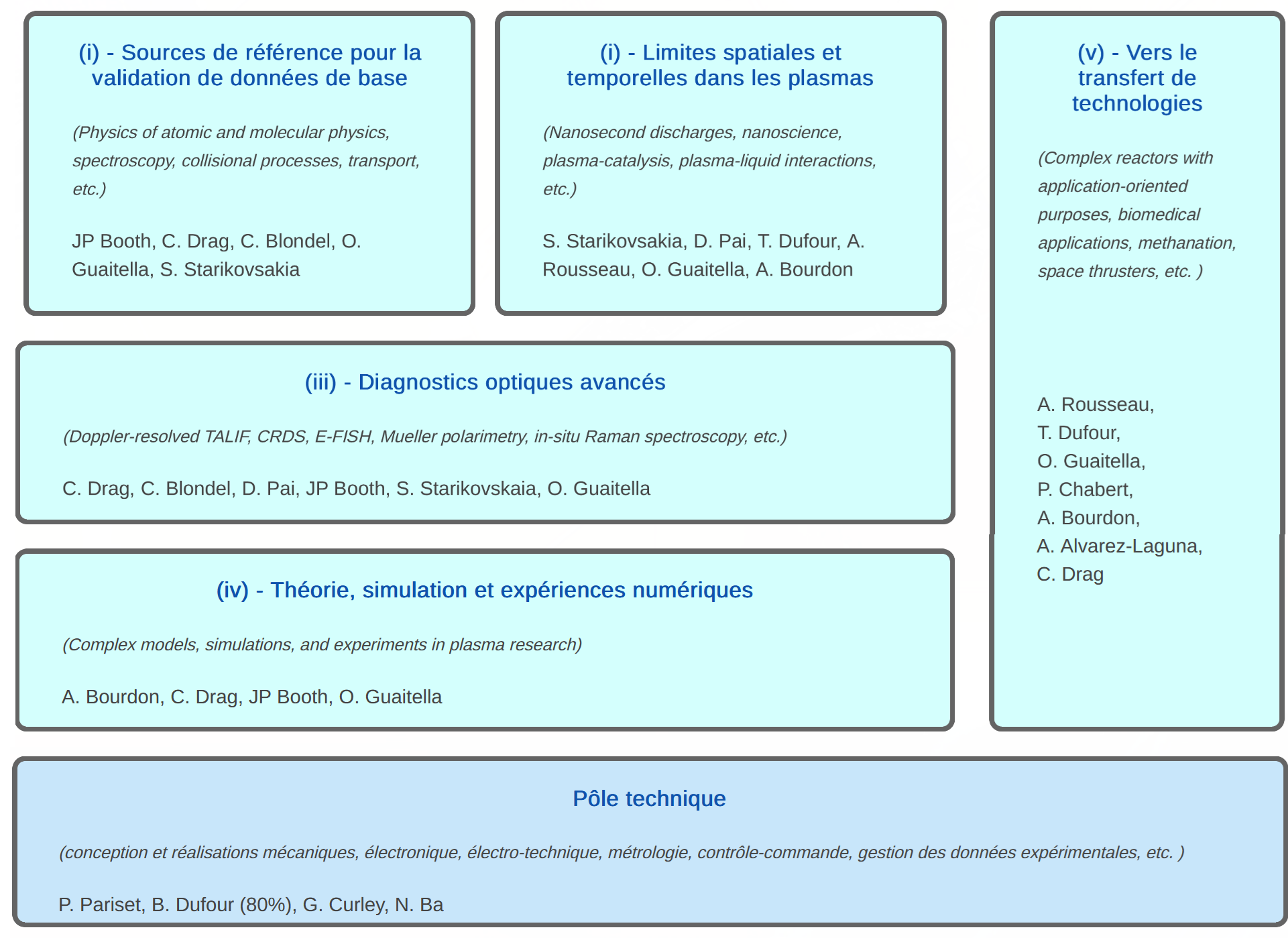
Collision processes, whether elastic or inelastic and involving charged or neutral species, control particle energy distributions (electrons, ions, rovibrational states, etc.), which can deviate significantly from a Maxwell–Boltzmann distribution. Energy transport mechanisms in systems with strong spatio-temporal gradients are also crucial to describe these environments. Moreover, plasma studies cannot be separated from interactions with the surfaces they contact. All these aspects often suffer from a lack of fundamental theoretical and/or experimental data necessary to build predictive models. To address these challenges, the team structures its activities around five main axes.
The first axis, (i) - Reference sources for the determination of fundamental data, aims at designing simple reactors to isolate the effect of individual collision processes, providing strict constraints on cross-section values or reaction rate constants. This axis also includes spectroscopic experiments dedicated to determining atomic quantities.
The second axis, (ii) - Spatial and temporal limits in plasmas, focuses on complex plasma sources at the limits of spatio-temporal scales studied so far in cold plasmas (nanosecond and nanometer scales).
These two axes rely on the development of advanced optical diagnostics in the third axis, (iii) - Advanced optical diagnostics.
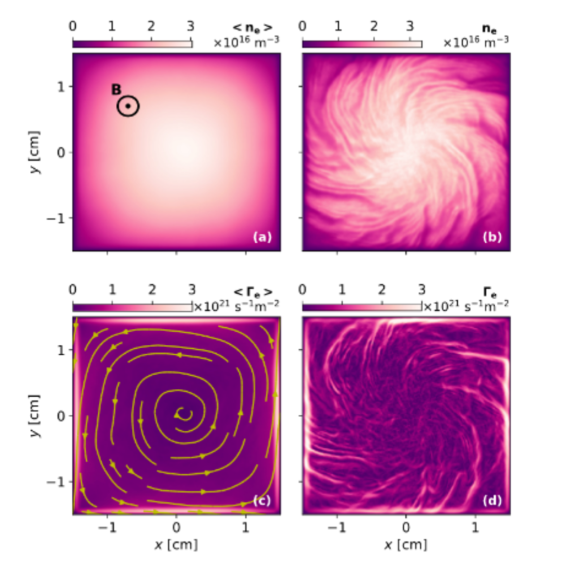
The fourth axis, (iv) - Theory, simulation and numerical experiments, focuses on theoretical tools and numerical simulations closely linked to experimental measurements, either by developing quantitative comparisons or enabling interpretation of experimental signals through numerical reproduction of experiments.
The work carried out in axes (i) to (iv) provides an in-depth understanding of the systems studied, forming the basis for the development of innovative application systems at the core of technology transfer, constituting the fifth research axis: (v) - Toward technology transfer.
Finally, the team’s experimental facilities benefit from the expertise of the technical support group, which manages experimental setup and maintenance and actively contributes to new developments.
- Alejandro Alvarez-Laguna | CNRS researcher
- Christophe Blondel | CNRS researcher
- Jean-Paul Booth | CNRS researcher
- Anne Bourdon | CNRS researcher
- Pascal Chabert | CNRS researcher
- Cyril Drag | CNRS researcher
- Thierry Dufour | Associate Professor at Sorbonne Université
- Olivier Guaitella | Polytechnique researcher
- David Pai | CNRS researcher
- Jean-Luc Raimbault | Associate Professor at Université Paris-Saclay
- Antoine Rousseau | CNRS researcher
- Svetlana Starikovskaia | CNRS researcher
- Tsanko Tsankov | Junior CNRS professor
- Nadjirou Ba
- Garrett Curley
- Pascal Pariset
- PhD Students
- Pierre Amadio
- Jean-Baptiste Billeau
- Blandine Berdugo
- Anatole Berger
- Sophie Bravo
- Elena Capuzzo
- Alexandre Desparmet
- Korentin Géraud
- Benjamin Labérie
- Victor Lafaurie
- Nicolas Lequette
- Thi Huyen Nguyen
- Eve Pachoud (collaboration with ONERA)
- Romain Pioch (collaboration with ONERA)
- Kasidapa Polprasarn
- Louis Reboul (collaboration with CMAP)
- Louis Saugé
- Dihya Sadi
- Zhan Shu
- Ayah Taihi
- Léna Taras
- Yuhui Wang
- Shu Zhang
- Post-doctoral researchers & Temporary contracts
- Edmond Baratte
- Maik Budde
- Rodolphe Da Silva
- Antoine Herrmann
- Sijun Kim
- Jeoffrey Kreyder
- Federico Petronio
- Manon Soulier