





Congratulations to Sascha Rienäcker for successfully defending his thesis titled “Impact of Magnetic Geometry on the Edge Radial Electric Field in Tokamaks”
10 Mar. 2026
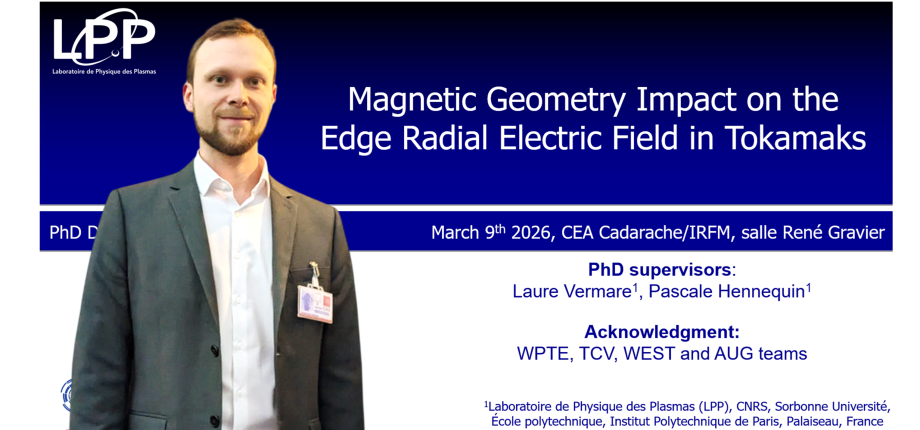
Congratulations to Sascha Rienäcker for successfully defending his thesis titled “Impact of Magnetic Geometry on the Edge Radial Electric Field in Tokamaks” on March 9th, 2026.
- Abstract
- Mitigating plasma turbulence is a major objective of magnetic confinement fusion research, as the resulting transport of heat and particles largely determines confinement quality and thus, the performance and cost of future fusion power plants.
- Sheared plasma flows play a central role in regulating turbulent transport, enabling, in particular, the formation of transport barriers associated with high confinement regimes. Even in low confinement mode (L-mode), tokamak plasmas typically exhibit a narrow ExB shear layer just inside the last closed fieldline surface (LCFS), corresponding to a negative radial electric field (Er) “well”. However, a deep understanding of the role of this Er well in setting L-mode confinement properties and in providing access to higher confinement regimes is still lacking. In addition, the sensitivities of Er to plasma conditions remain poorly understood and difficult to capture using existing models or numerical tools.
- This PhD thesis investigates these sensitivities experimentally to help disentangle the dominant Er drives in L-mode and clarify their role in confinement improvement or transitions. Experiments are primarily conducted on the TCV tokamak, using a newly installed Doppler backscattering (DBS) diagnostic to characterize the edge Er profile. Systematic parameter scans are performed in carefully matched discharges to isolate the impact of magnetic drift configuration and plasma shaping (specifically, triangularity) on the mean Er and other edge profiles. Overall, the findings support a link between edge Er shear and the influence of magnetic geometry on confinement properties. Combined with recent first-principles simulations, the observations point to the importance of turbulence-driven flow generation in explaining sensitivities of Er to magnetic geometry.
- Location of the defense: CEA Cadarache–IRFM, salle René Gravier
- Jury Committee:
- Teresa ESTRADA CIEMAT Reviewer
- Gregor BIRKENMEIER IPP Garching Reviewer
- Guido CIRAOLO CEA (IRFM) Jury Chair
- Benoît LABIT EPFL (SPC) Examiner
- Laure VERMARE CNRS (LPP) PhD Supervisor
- Pascale HENNEQUIN CNRS (LPP) PhD Supervisor
- Branka VANOVAC MIT Invited Member
- Yann CAMENEN AMU, CNRS (PIIM) Invited Member