


Francisco Javier Polanco-Rodriguez successfully defended his PhD thesis on electromagnetic emissions generated by Type III solar radio bursts
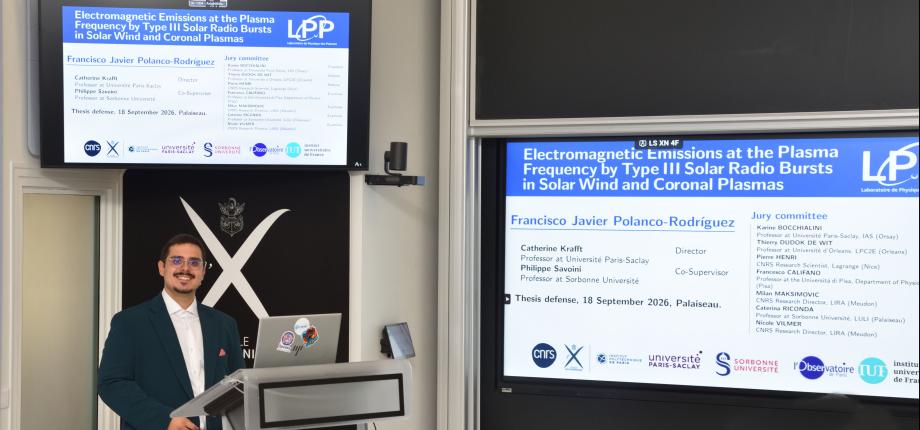
Congratulations to Francisco Javier Polanco-Rodriguez, who successfully defended his PhD thesis entitled "Electromagnetic Emissions at the Plasma Frequency by Type III Solar Radio Bursts in Solar Wind and Coronal Plasmas".
- Summary
Type III solar radio bursts are produced by near-relativistic electron beams accelerated in the solar corona that propagate along open magnetic field lines into the solar wind. These beams generate Langmuir/Z-mode (LZ) wave turbulence, which is converted into electromagnetic radiation near the plasma frequency ωₚ and its harmonics through a sequence of linear and nonlinear wave processes known as plasma emission. Despite more than seventy years of research, the mechanisms responsible for plasma emission in the randomly inhomogeneous and weakly magnetized solar wind plasma remain incompletely understood.
We study plasma emission at ωₚ under realistic Type III burst conditions from 0.05 to 1 au by combining long-term, large-scale 2D/3V (two dimensions in space and three in velocity) Particle-In-Cell (PIC) simulations, theoretical modeling, and analysis of in situ wave measurements from the Solar Orbiter spacecraft. The two-dimensional PIC simulations performed in this thesis are the first to study the beam-plasma system under conditions that simultaneously include realistic beam and plasma parameters, highly resolved electromagnetic and electrostatic scales, high- and low-frequency dynamics, plasma magnetization and random density fluctuations. Moreover, we provide a new framework for connecting PIC simulations with spacecraft observations of radio-emitting space plasmas by developing a virtual satellite technique.
Within this framework, we show in detail how the main processes leading to electromagnetic emission at ωₚ are interconnected, interact and compete with one another, and how they are impacted by plasma magnetization. The weak ambient magnetic field modifies the electrostatic decay of LZ wave turbulence through the appearance of a small-wavenumber boundary layer that prevents LZ wave energy condensation and favors instead the radiation of electromagnetic Z-mode waves near ωₚ. In addition to this new channel of electromagnetic radiation evidenced through PIC simulations, we provide the first in situ evidence for the decay of LZ waves into Z-mode waves during a Type III burst observed by the Solar Orbiter spacecraft, in the solar wind.
We also demonstrate that, in magnetized and randomly inhomogeneous radio sources, linear mode conversion at constant frequency of LZ wave turbulence into electromagnetic waves is the fastest and most efficient mechanism. Radiation is predominant in the Z mode, while only ~10% of the emitted energy can escape the source in the form of O-mode waves and, under specific conditions only, of X-mode waves. Moreover, linear mode conversion is shown (i) to be closely linked to the polarization ratios of LZ wavepackets, thereby providing new insight into the properties of LZ wave turbulence, and (ii) to play a crucial role in stimulating slower nonlinear three-wave interactions.
Finally, the electromagnetic decay (the nonlinear three-wave interaction process long regarded as the main mechanism of plasma emission at ωₚ in homogeneous and unmagnetized plasmas) is evidenced for the first time in realistic PIC simulations of Type III bursts, as well as its transition to nonlinear induced scattering on thermal ions when ion acoustic waves become damped. This electromagnetic decay is also shown to be stimulated by the electrostatic decay.
- Date and location of the defense
- September 18, 2026, at 2:00 p.m.
- Jean-Lascoux Lecture Hall, Wing 0, École Polytechnique Laboratories, Palaiseau
- PhD defense committee
- Karine BOCCHIALINI - Professor at Université Paris-Saclay, IAS (Orsay)
- Thierry DUDOK DE WIT - Professor at Université d'Orléans, LPC2E (Orléans)
- Pierre HENRI - CNRS Research Scientist, Lagrange (Nice)
- Francesco CALIFANO - Professor at the University of Pisa, Department of Physics (Pisa)
- Milan MAKSIMOVIC - CNRS Research Director, LIRA (Meudon)
- Caterina RICONDA - Professor at Sorbonne Université, LULI (Palaiseau)
Nicole VILMER - CNRS Research Director, LIRA (Meudon)