





Iodine electric propulsion: Laser diagnostics for characterization of I⁺ ions
21 Oct. 2026
- Romain Pioch (postdoctoral researcher), Marie-Alix Sagnimorte (École Polytechnique intern), Benjamin Esteves (Safran), and Cyril Drag (CNRS) have recently published a study in Physical Review E focusing on the diagnostics of iodine plasmas for space electric propulsion. This research also earned Marie-Alix Sagnimorte the “École polytechnique Department of Physics Research Internship Award” for the 2026 edition.
- Iodine is currently considered a promising alternative to xenon. Solid under standard conditions, iodine readily sublimates into molecular gas and is easily ionized in a plasma. However, electrical energy in these plasmas is also dissipated through other processes, including electron heating, molecular vibrational and rotational excitation, and negative ion formation. Until recently, iodine plasmas had received relatively little attention in laboratory studies, highlighting the need to develop suitable, non-intrusive diagnostic techniques.
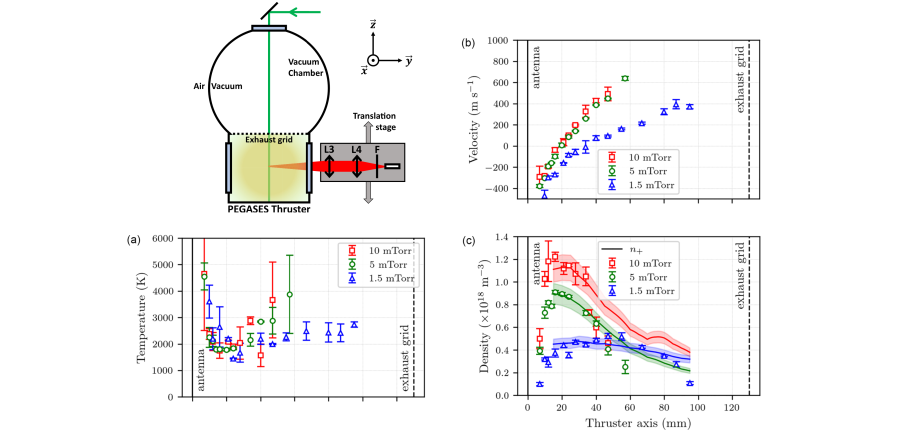
- In this work, Cyril Drag and his collaborators implemented a laser-induced fluorescence (LIF) technique to probe I⁺ ions in the PEGASES plasma source. The ions are illuminated by a finely tuned laser, and analysis of the emitted fluorescence allows local measurements of their temperature, velocity, and relative density. The selected I⁺ transition, at 516.261 nm, was investigated, and its hyperfine structure—which splits the resonance line into several closely spaced components—was characterized to ensure accurate interpretation of the measured fluorescence profiles.
- The technique was applied to the ionization chamber of PEGASES, a radio-frequency inductively coupled gridded ion thruster, operating at pressures ranging from 0.5 to 10 mTorr (0.07 to 1.33 Pa). Mapping the ion temperatures, velocities, and densities within the source revealed three key findings. First, excited-state ions exhibit higher temperatures near the antenna that powers the plasma. Second, the Doppler shift of the fluorescence signals reveals ion acceleration toward the grid. Third, comparison with previous electron density measurements indicates that the population of ions in the probed excited state remains proportional to that in the ground state. Consequently, detecting ions in this electronically excited state provides a means of monitoring the overall ion population.
- These results demonstrate that LIF is a particularly suitable non-intrusive optical diagnostic technique for iodine plasmas, offering promising opportunities for investigating and optimizing future electric propulsion systems, including Hall-effect thrusters.
- Publication details
- Title: Laser induced fluorescence of singly ionized atomic iodine: Measurements in the plasma source of an electric propulsion device
- Authors: Romain Pioch, Marie-Alix Sagnimorte, Benjamin Esteves, and Cyril Drag
- Journal: Physical Review E, 114, 035201
- DOI: https://doi.org/10.1103/jmh3-hwd8