





Lina Hadid receives the SF2A 2026 Young Researcher Award
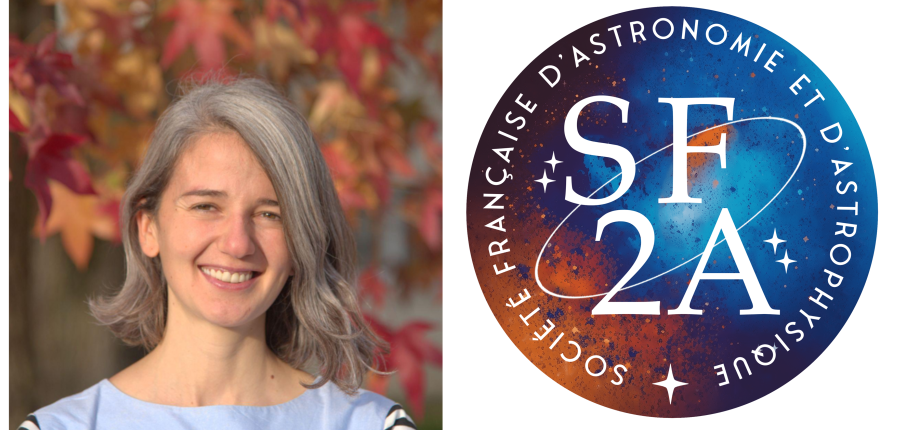
The Laboratoire de Physique des Plasmas warmly congratulates Lina Hadid, CNRS research scientist at the laboratory, who has been awarded the 2026 Young Researcher Award by the French Society of Astronomy and Astrophysics (SF2A).
With this distinction, the SF2A Council recognizes Lina Hadid for the quality and originality of her work in space plasma physics, particularly on interactions between the solar wind and planetary environments, as well as for her strong commitment to the scientific community.
Lina Hadid’s research focuses on the dynamics of collisionless plasmas in the heliosphere and planetary magnetospheres. By combining space data analysis, physical interpretation, and instrument development, she contributes to a better understanding of the mechanisms governing energy transfer and dissipation in space plasmas.
A significant part of her work concerns the study of turbulence in space plasmas, a key process for understanding the behavior of the solar wind and planetary environments. Since her PhD, she has investigated the role of compressible fluctuations in turbulence observed in particular around Saturn, showing that plasma compressibility can significantly modify energy cascade rates and contribute to plasma heating. She also provided the first estimate of the heating rate in Earth’s magnetosheath, revealing that it can be more than one hundred times higher than that measured in the solar wind.
Her research has since expanded to the study of the solar wind in the inner heliosphere, thanks in particular to observations from the Parker Solar Probe and Solar Orbiter missions, with multi-spacecraft analyses making it possible to track the evolution of turbulent structures at different distances from the Sun.
This expertise in diverse planetary environments extends to her major role in the scientific exploitation of the BepiColombo mission to Mercury. Among the notable results obtained during the cruise phase, the analysis of data from the MSA ion mass spectrometer during a flyby of Venus made it possible to reveal, for the first time, the escape of heavy planetary ions such as oxygen and carbon along the flanks of the planet’s induced magnetosphere.
Strongly involved in instrument development, Lina Hadid is currently PI of the Mass Spectrum Analyzer (MSA) onboard the Mio orbiter of BepiColombo and co-PI of the Mercury Plasma Particle Experiments (MPPE) consortium. She is also involved in several major international missions, including JUICE (ESA), Solar Orbiter (ESA-NASA), and MMX (JAXA).
The SF2A Council also wished to highlight the breadth of her scientific responsibilities, her commitment to fostering the international scientific community, and her dedication to mentoring young scientists and promoting scientific culture.
This distinction will be presented during the 2026 French Week of Astrophysics, which will take place from 22 to 26 June 2026 in Grenoble.