LPP Seminar – Simon Chouteau: Probabilistic Diagnostics of Argon Plasmas Using Optical Spectroscopy
Share
LPP Seminar – Simon Chouteau: Probabilistic diagnostics of argon plasmas using optical spectroscopy
09 Sep. 2026
The LPP will host Simon Chouteau, a postdoctoral fellow of the Japan Society for the Promotion of Science (JSPS) at Osaka University, for a seminar devoted to non-invasive diagnostics of low-temperature plasmas using optical spectroscopy.
Friday, September 11 at 10:00 – Salle Jean Lascoux (Wing 0), École Polytechnique, Palaiseau
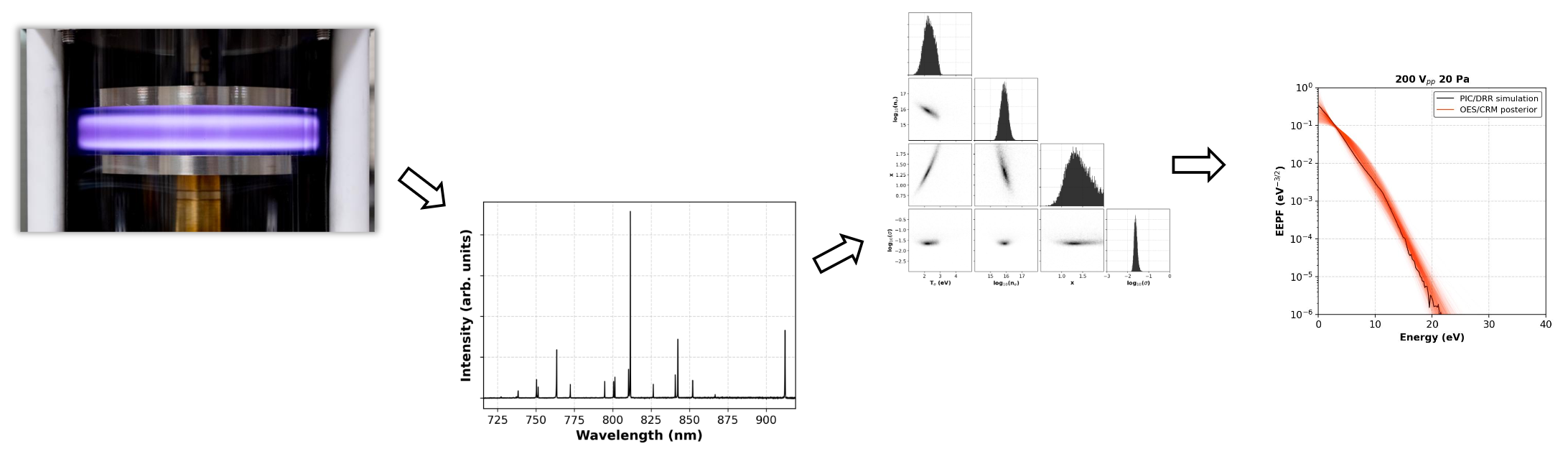
The seminar, entitled “Probabilistic approach to non-invasive diagnostic of electron energy distribution functions in low-temperature argon plasmas”, will present a probabilistic approach to extracting quantitative information from optical emission spectroscopy (OES) measurements.
OES is a particularly attractive non-intrusive diagnostic for low-temperature plasmas, but the information it provides on fundamental plasma properties is often indirect. This work aims in particular to determine excited-state densities, electron density, and the electron energy distribution function (EEDF) in argon plasmas by combining line intensity ratios, collisional-radiative modelling, and probabilistic methods.
The results show good agreement with independent laser absorption measurements and first-principles simulations over a relatively wide range of experimental conditions. The seminar will also discuss the specific features of this probabilistic framework and possible strategies for further improvement.
About Simon Chouteau After completing an international programme between the University of Toulouse and INRS in Canada, Simon Chouteau carried out a joint PhD between the Université de Montréal and Université de Nantes. His doctoral research focused on plasma–surface–droplet interactions in plasma-assisted thin-film deposition processes. Since 2024, he has been a JSPS postdoctoral fellow in Prof. Satoshi Hamaguchi’s group at Osaka University, where he is developing diagnostic methods combining optical emission spectroscopy and collisional-radiative modelling.