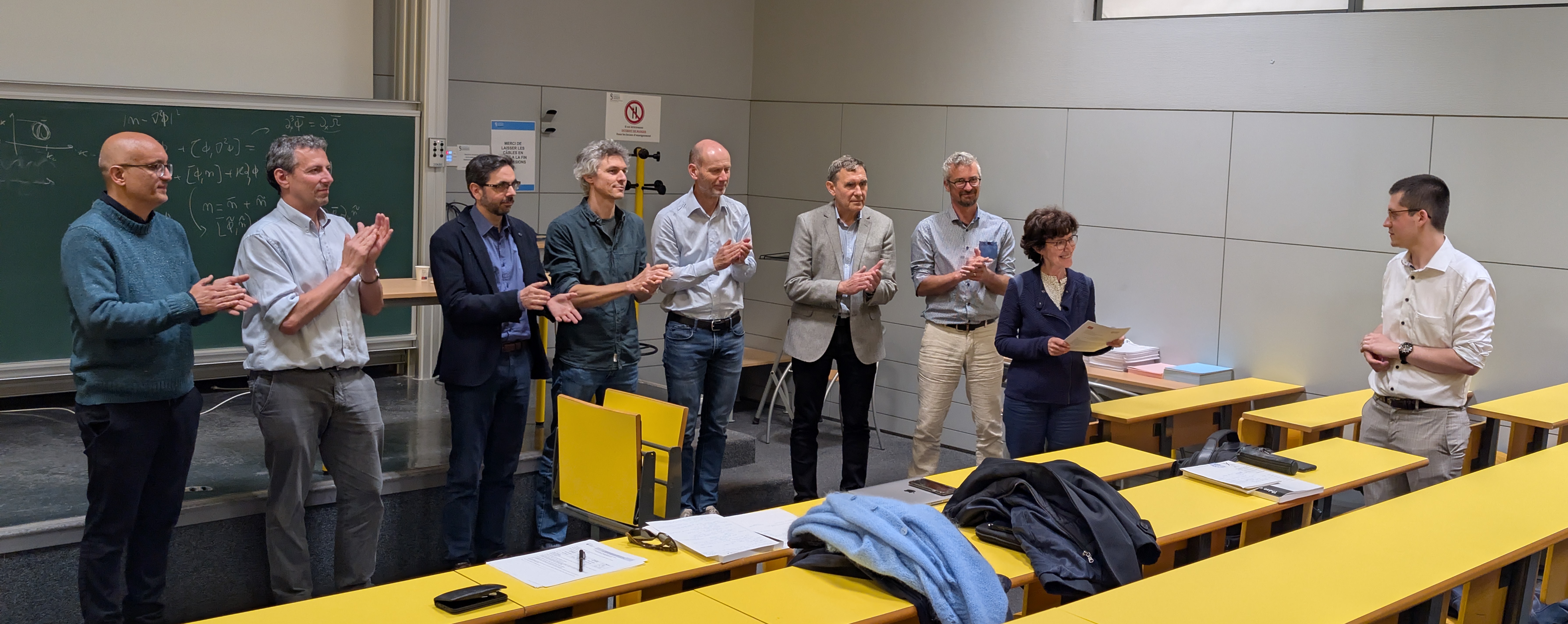





Pierre GUILLON successfully defended his doctoral thesis on the transport modelling for fusion devices using reduced models for turbulence
12 Jun. 2026
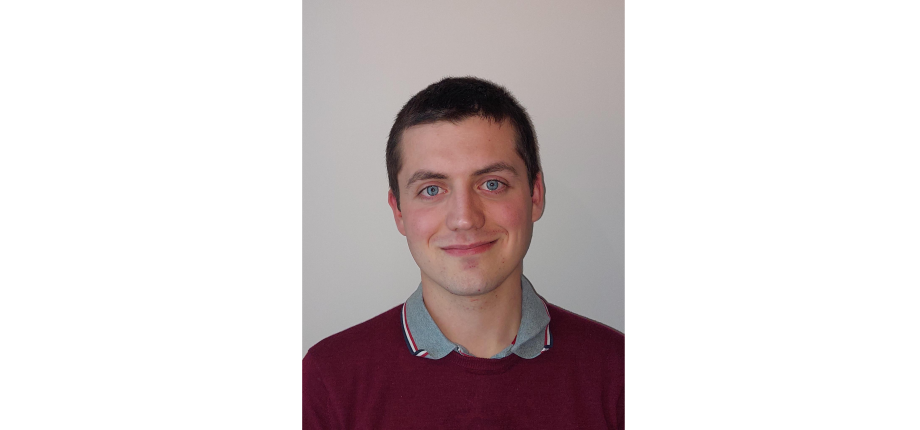
- Congratulations to Pierre Guillon, who successfully defended his thesis entitled “Transport Modelling for Fusion Devices Using Reduced Models for Turbulence”
- Absract
- The goal of this thesis is to develop and improve reduced models for turbulent transport in tokamak plasmas, using the mini mal non-trivial model for instability-driven tokamak plasma turbulence: the Hasegawa-Wakatani (HW) system. Despite its simplicity, this two-dimensional fluid system already displays complex phenomena observed in more realistic systems, such as zonal flows (ZFs) as an example of self-organisation, and a transition from turbulence to ZFs as its linear parameters are varied.
- First, the transition is explored in details, and seen as a phase transition between a “hot” disordered state, and a “colder”, one-dimensionalised, organised state. Defining the fraction of zonal energy as the order parameter, and the ratio of linear parameters as the control parameter, a sharp transition is observed that moreover exhibits a hysteresis loop. The hysteresis is interpreted as a consequence of ZFs stabilising the system once they are formed, and requiring some energy akin to latent heat in order to collapse.
- The transition is then reproduced in a system reduced to a few Fourier modes. A theoretical understanding for the transition in that model is provided. The particle flux-driven HW system is then considered, in which the mean density profile evolves in response to the turbulent flux and external sources. To perform pseudo-spectral simulations of a flux-driven system with non-periodic boundary conditions, the P-FLARE code is developed, which relies on the penalisation method. Introducing a source of density, close to the threshold of the transition previously observed, results in sandpile-like critical behaviour and profile stiffness. The latter is argued to be a manifestation of the hysteresis in the ZF level.
- Finally, Poloidally Truncated Models (PTMs), based on a severe truncation of Fourier modes along the poloidal direction, while retaining the full radial direction, are investigated. It is found that at least 4 poloidal modes, distributed around the most unstable mode, are needed to correctly reproduce direct numerical simulation (DNS) results in both fixed-gradient and flux-driven systems.
- Date and Venue of the Defense
- June 10, 2026, at 2:00 p.m.
- Room 24-34-509, Pierre & Marie Curie Campus, Sorbonne University
- Examination Committee
- Pascale Hennequin, Research Director, CNRS (LPP): president
- Xavier Garbet, Professor, Nanyang Technological University and CEA (IRFM): reviewer
- Etienne Gravier, Professor, Université de Lorraine (Institut Jean Lamour): reviewer
- Alberto Bottino, Research Director, Max Planck Institute (IPP Garching): examiner
- Matteo Faganello, Associate Professor, Aix-Marseille University (PIIM): examiner
- Fulvio Militello, Research Director, UKAEA (CCFE): examiner
- Özgür Gürcan, Research Scientist, CNRS (LPP): thesis supervisor
- Nicolas Fedorczak, Research Scientist, CEA (IRFM): thesis co-supervisor