





Plasma Observatory selected as ESA M7 mission
Following the recommendation of the Science Programme Committee (SPC) of the European Space Agency (ESA), ESA Member States have selected Plasma Observatory [1] as the Agency's first medium-class mission to be implemented under the ESA Voyage 2050 Science Programme [2].
The Plasma Observatory mission will make transformative advances in two major challenges of fundamental plasma physics: understanding how plasma is energized [3] and how energy is transported across space plasmas [4]. To achieve this, the mission will perform, for the first time, three-dimensional, multi-scale measurements throughout the Earth's Magnetospheric System. This will be accomplished using a constellation of seven identical, spinning spacecraft (Sister SpaceCraft) in highly elliptical Earth orbits. Each spacecraft will carry out advanced measurements of particle distribution functions and electromagnetic fields simultaneously at fluid and ion-kinetic scales, across the key regions of the magnetosphere: the foreshock, bow shock, magnetosheath, magnetopause, magnetotail current sheet and transition region [5].
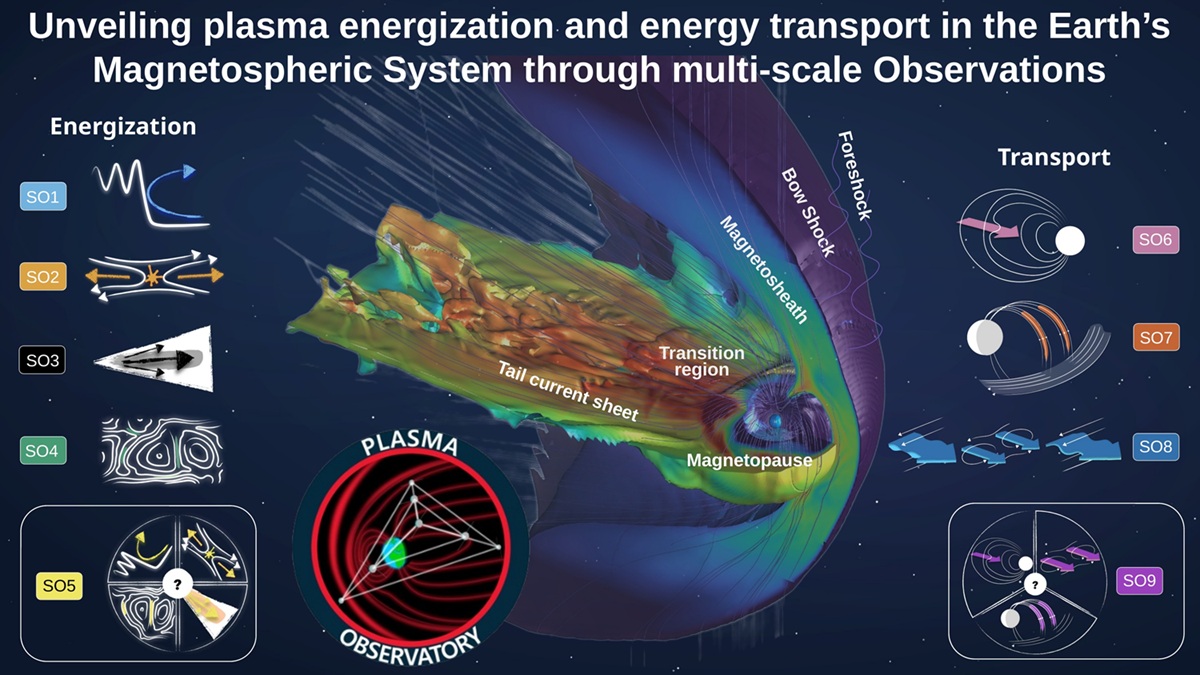
Figure 1: Plasma Observatory science theme and objectives. Simulation of the Magnetospheric System from the Vlasiator code (courtesy M. Alho, Univ. of Helsinki).Figure 1 : Thème scientifique et objectifs de Plasma Observatory. Simulation du Système Magnétosphérique à l'aide du code Vlasiator (Crédit illustration : M. Alho, Université d'Helsinki).
Plasma Observatory represents a major milestone for the French and international space plasma physics community. It is the outcome of more than 20 years of sustained scientific and technological effort, building on the pioneering ESA Cluster mission [6]—the first scientific spacecraft constellation in near-Earth space—and subsequently on the THEMIS and MMS missions. By going beyond the single-scale measurements achieved by these missions, Plasma Observatory will open new avenues for research into magnetic reconnection, turbulence, shocks, plasma jets and instabilities, all central topics in the research activities of LPP and the wider French space plasma physics community. These advances are essential not only to understanding how our planet and its magnetosphere operate, including the processes driving space weather, but also to addressing fundamental questions about the Plasma Universe, with important implications for astrophysical and laboratory plasmas.
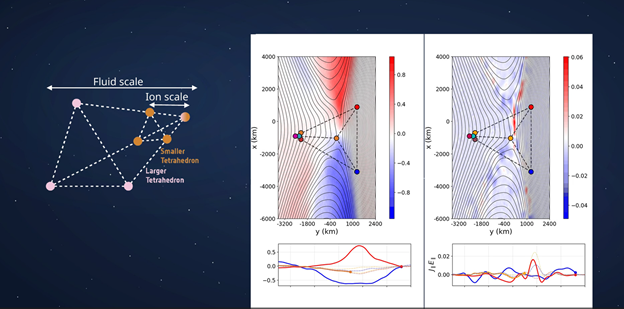
Figure 2: Plasma Observatory virtual spacecraft observations of a reconnection region. Simulations by M. Baraka (LPP).Figure 2 : Observations d'une région de reconnexion par satellites virtuels simulant Plasma Observatory. Simulations réalisées par M. Baraka (LPP).
Plasma Observatory holds top priority within the ESA Voyage 2050 Science Programme, encompassing two science themes designated for ESA-led medium-class missions: "Magnetospheric Systems" and "Plasma Cross-scale Coupling". Furthermore, it constitutes a pivotal element of the CNES Solar-Heliosphere-Magnetospheres (SHM) past and current roadmaps.
The Laboratory of Plasma Physics (LPP) plays a leading role in Plasma Observatory, both scientifically and technologically. A. Retinò is co-lead proposer of the mission and co-leads its Science Consortium alongside the lead proposer, M. F. Marcucci (IAPS-INAF, Rome) [7]. Two of the mission's eight instruments are led by LPP scientists: M. Berthomier and O. Le Contel serve as Instrument Lead Scientists (ILSs) for the ion Electron Plasma Camera (iEPC) and the Search Coil Magnetometer (SCM), respectively. LPP also contributes to the Ion Mass Composition Analyzer (IMCA), led by IAPS-INAF, with A. Retinò serving as co-ILS. All are members of the ESA-appointed Science Study Team, which is responsible for guiding the scientific definition of the mission throughout its study phases (0/A/B1). Several other LPP scientists, including early career scientists, are also members of Plasma Observatory thematic Working Groups (numerical simulations, multi-point data analysis methods, plasma astrophysics) [7].
The LPP payload contribution, supported by the French Space Agency (CNES), builds on the internationally recognized expertise of its Space Plasmas Group in space plasma instrumentation. It combines innovative measurement concepts with highly mature technological developments, drawing on decades of experience in the design and development of instruments for space missions.
Ion Electron Plasma Camera (iEPC). The pair of plasma cameras, to be flown on each of the seven Sister SpaceCraft, combines a novel, game-changing electrostatic optical design using innovative 3d-printing technology with an advanced ASIC-based plasma imaging detection system. It has been developed through CNES R&T and demonstration programs. It will measure three-dimensional distribution functions of thermal ions and electrons at high time resolution, down to plasma kinetic timescales, while requiring substantially less mass, volume and power than conventional state-of-the-art plasma spectrometers. These measurements are essential for quantitatively investigating particle energization mechanisms across multiple spatial and temporal scales.
The LPP iEPC team brings together the extensive experience of senior scientists and engineers, including M. Berthomier, F. Leblanc, J.-D. Techer and Y. Alata, with the contributions of several highly motivated early-career engineers (G. Henaff, E. Seneret, G. Poggia and E. Daniello). The iEPC consortium led by LPP includes MSSL (UCL, United Kingdom), IRAP (Toulouse), and LAB (Bordeaux) teams which have extensive heritage in the development of plasma spectrometers for space science missions.
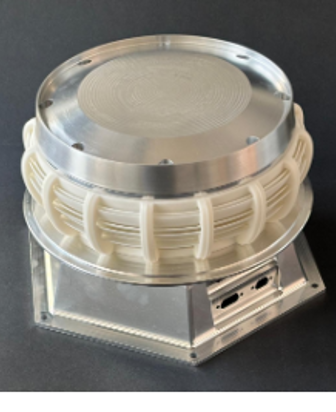
Figure 3: The ion Electron Plasma Camera (iEPC) instrument.
Search Coil Magnetometer (SCM). The SCM instrument builds on LPP's more-than-three decades of expertise and international leadership in the development of search-coil magnetometers for space plasma missions, including Cluster, THEMIS, MMS, BepiColombo and JUICE. It benefits directly from the technological heritage of the JUICE SCM instrument, which is currently operating during the mission's cruise phase. The Plasma Observatory SCM will provide high-sensitivity, three-dimensional measurements of magnetic fluctuations on each Sister SpaceCraft. These measurements will make it possible to quantitatively investigate wave-particle interactions and their role in particle energization and energy transport across multiple scales. The SCM instrument is led by LPP and includes experienced scientists and engineers, notably O. Le Contel (ILS), D. Alison and J. Gironnet, working in close collaboration with LPC2E (Orléans), which is the co-ILS laboratory.
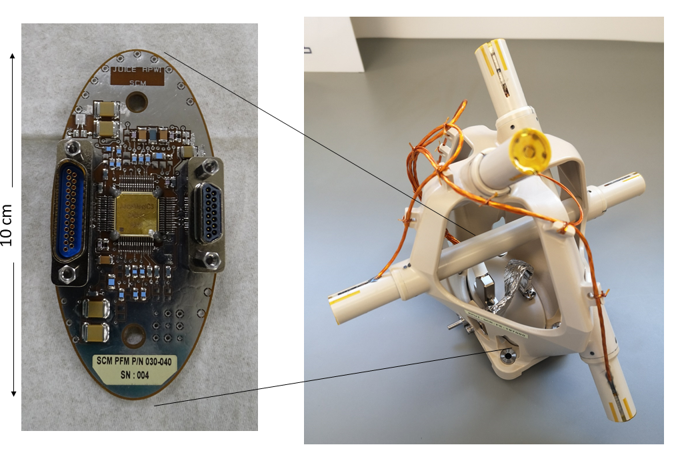
Figure 4: The Search Coil Magnetometer (SCM) instrument (JUICE spare model). Left: ASIC pre-amplifier developed by LPP in collaboration with GeePs, Sorbonne University. Right: magnetic sensors and mechanical structure developed by DT-INSU.
Ion Mass Composition Analyzer (IMCA). LPP's contribution to the IMCA instrument draws on its expertise in developing application-specific integrated circuits (ASICs) for particle detector systems. In particular, LPP has developped an innovative Time-of-Flight (ToF) ASIC during Plasma Observatory Phase A, under the responsibility of J.-D. Techer. This development builds on the ASIC originally designed for ESA's THOR mission during its Phase A study (2015–2017) and subsequently tested in the laboratory and under radiation conditions with the support of C. Le Bomin. The ToF ASIC is a key component of IMCA, enabling the measurement of the time of flight of individual ion species and, consequently, the determination of their masses. Its development addresses the stringent mass, volume and power constraints of space instrumentation. It represents a particularly innovative electronic development and one of the few ASICs of this type specifically designed for applications in space plasma physics.
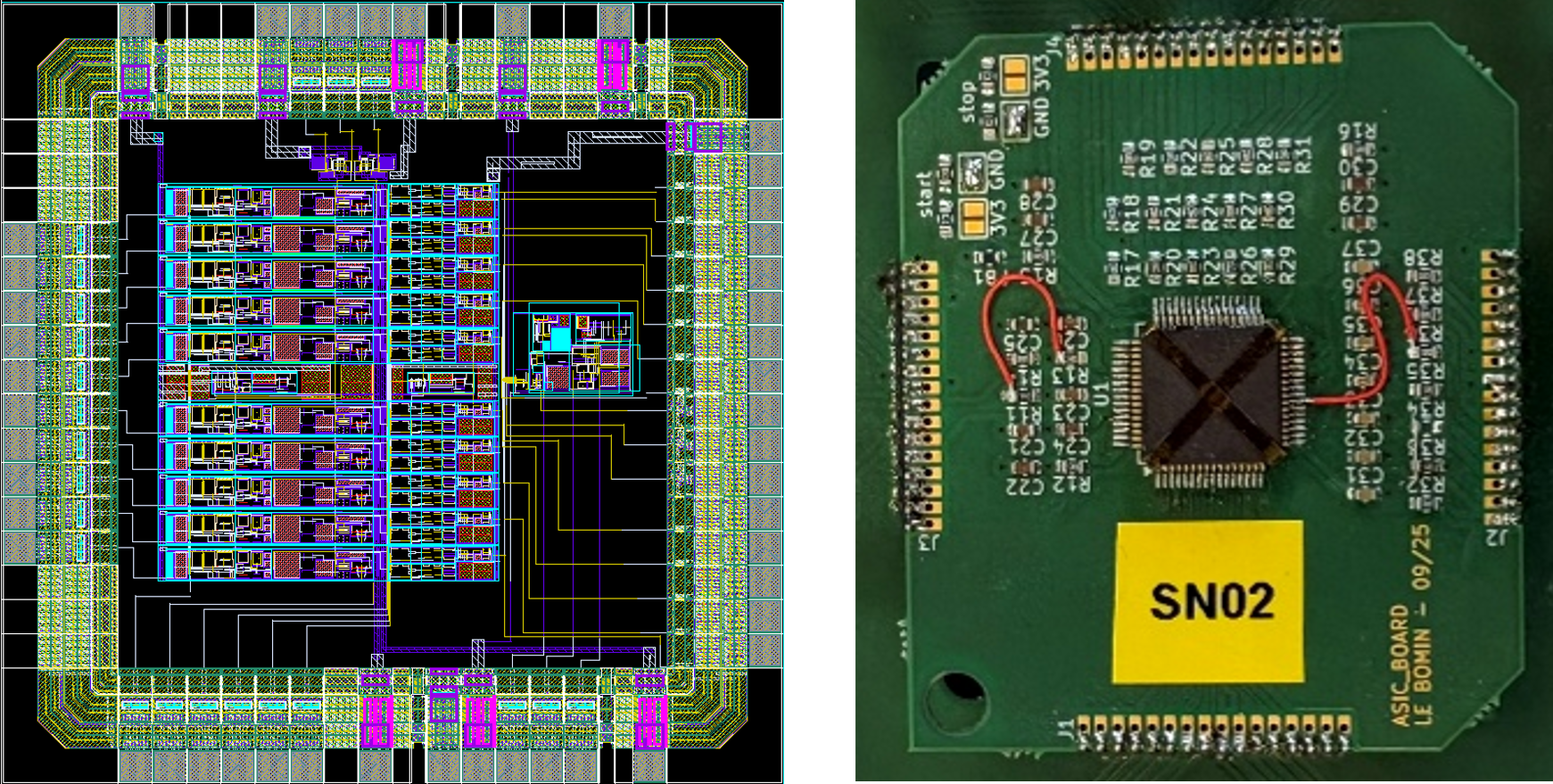
Figure 5: Prototype of the Time-of-Flight (ToF) ASIC of the Ion Mass Composition Analyzer (IMCA) instrument. Left: ASIc layout. Right: ASIC prototype on its test board.
Plasma Observatory is scheduled to enter Phase B1 in December 2026, with mission adoption expected in early 2030 and launch aboard an Ariane 6.4 launcher from Kourou towards the end of 2038.
Together with NASA's HelioSwarm mission (launch planned for 2030), which is specifically designed to investigate multi-scale plasma turbulence in the solar wind and also benefits from a major LPP contribution, Plasma Observatory will provide the French and international space plasma physics community with an unprecedented opportunity to play a leading role in the emerging era of multi-scale space plasma physics. Together, these missions have the potential to drive a paradigm shift in our understanding of space and astrophysical plasmas.
References
[3] https://link.springer.com/article/10.1007/s10686-021-09797-7
[4] https://link.springer.com/article/10.1007/s10686-022-09861-w
[6] https://www.esa.int/about-us/directorates/science/cluster