



Radiation efficiency of electromagnetic wave modes from beam-generated solar radio sources
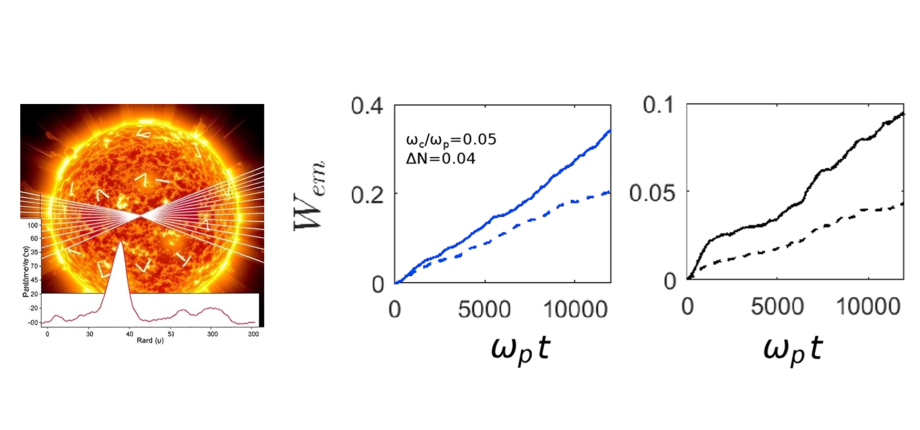
- During type III solar radio bursts, electromagnetic waves are radiated at the plasma frequency ωp and its harmonics by electrostatic wave turbulence generated by electron beams ejected from the Sun in solar wind and coronal plasmas. These emissions, detected for decades by spacecraft and radio-telescopes, are split by the plasma magnetic field into three modes, X, O and Z, with different dispersion, polarization and radiation properties.
- Using three independent and converging approaches—particle-in-cell simulations, a theoretical model of waves in a random medium and analytical calculations in the framework of weak turbulence theory—we demonstrate that only a small fraction (≲10%) of fundamental electromagnetic energy radiated at ωp escapes from beam-generated radio sources, mainly as O-mode waves and, depending on plasma conditions —mainly magnetization and level of density turbulence, as X-mode waves.
- Substantial radiation at ωp in X-mode can be only emitted by very weakly magnetized radio sources, which can be found near the Earth orbit. Most energy is radiated in the Z-mode which, due to its dispersive properties, can therefore be observed only inside or close to sources. Then, only partial information on the mechanisms of generation of electromagnetic emissions within turbulent radio sources is accessible at far distances from them.
- The radiation rates of the electromagnetic modes are provided as a function of the radio source parameters (temperature, magnetization, wave and density turbulence spectra).
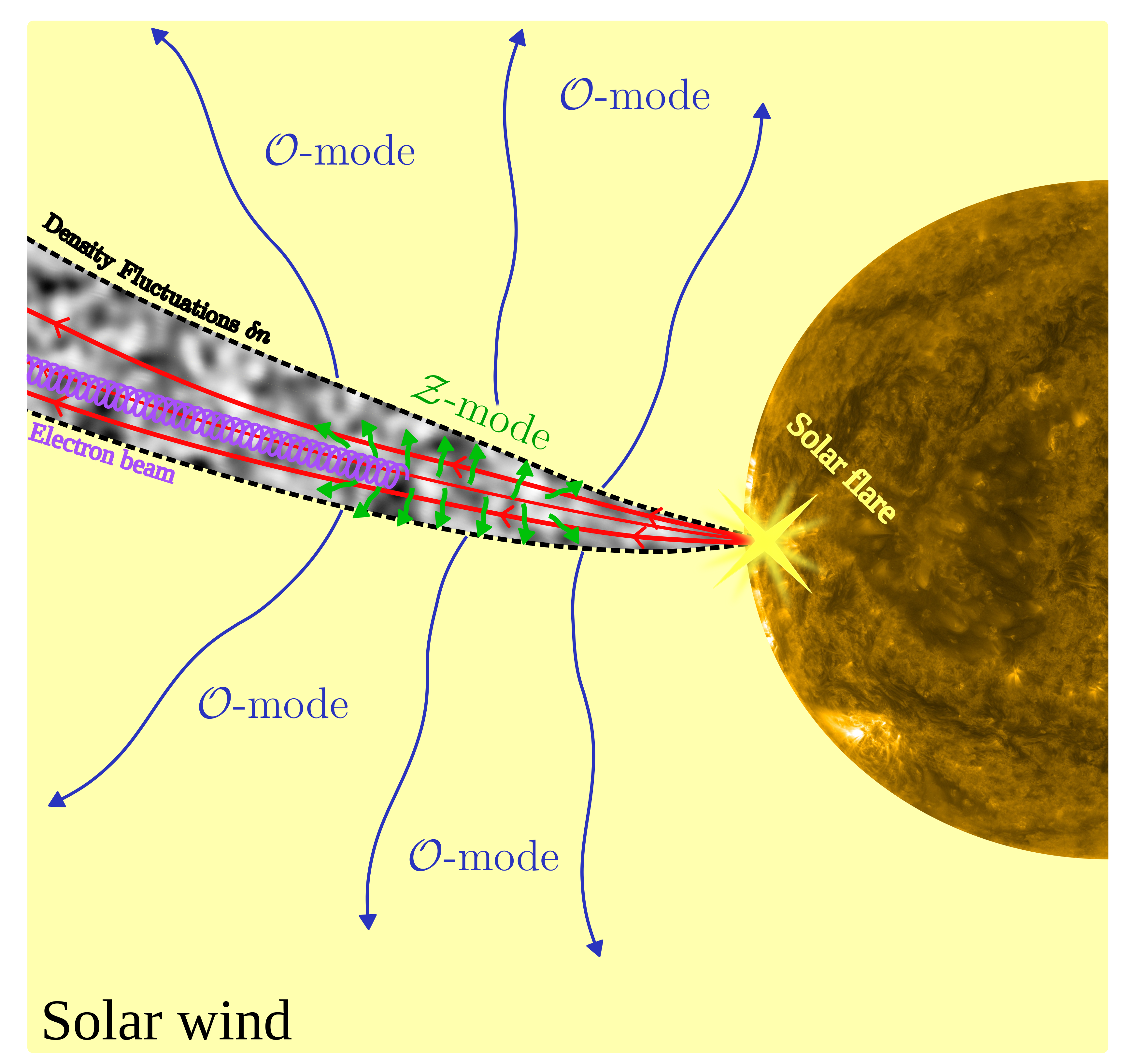
Figure 1 : Schematic representation of a solar flare (yellow), during which an energetic electron beam (purple) is ejected in the solar wind (light yellow). The beam propagates along open magnetic field lines (red) in the randomly inhomogeneous plasma (density turbulence). It generates wave turbulence that in turn radiates electromagnetic (EM) waves. The EM Z-mode waves remain in the radio source, whereas the EM O- and X- mode waves escape from it, depending on the distance of the source from the Sun. In the corona, only O-mode waves are radiated.
- This work, based on general approaches requiring few assumptions, makes it possible to study the properties of radio emission under realistic solar conditions, and thereby provides a solid basis for the development of theoretical tools for probing space and time variations of beam-plasma systems in the solar wind.
- The results obtained have been recently confirmed by Parker Solar Probe (PSP) observations at a distance of 13 solar radii during a storm of Type III radio bursts (Pulupa et al. ApJL 987:L34, 2025). The sense and degree of circular polarization of the electromagnetic waves observed is consistent with fundamental emission in the O-mode. Highly-polarized fundamental emissions in this mode were also observed by PSP at 17 solar radii (Jebaraj et al. ApJL, 955:L20, 2023).
- For more details see C. Krafft, A. Volokitin, F.J. Polanco-Rodriguez, & P. Savoini, Nature Astronomy, 9, 1292-1299, 2025.
- All authors are affiliated with the LPP laboratory. Catherine Krafft and Philippe Savoini are professors at Paris-Saclay University and Sorbonne University, respectively. Francisco Javier Polanco-Rodriguez is a PhD candidate, with his defense scheduled for September 2026. Alexander Volokitin, a long-standing collaborator from Russia, visits the LPP laboratory twice a year.
- The article has been popularized by the Science Magazine at https://scienmag.com/radiation-efficiency-in-beam-driven-solar-radio-waves/
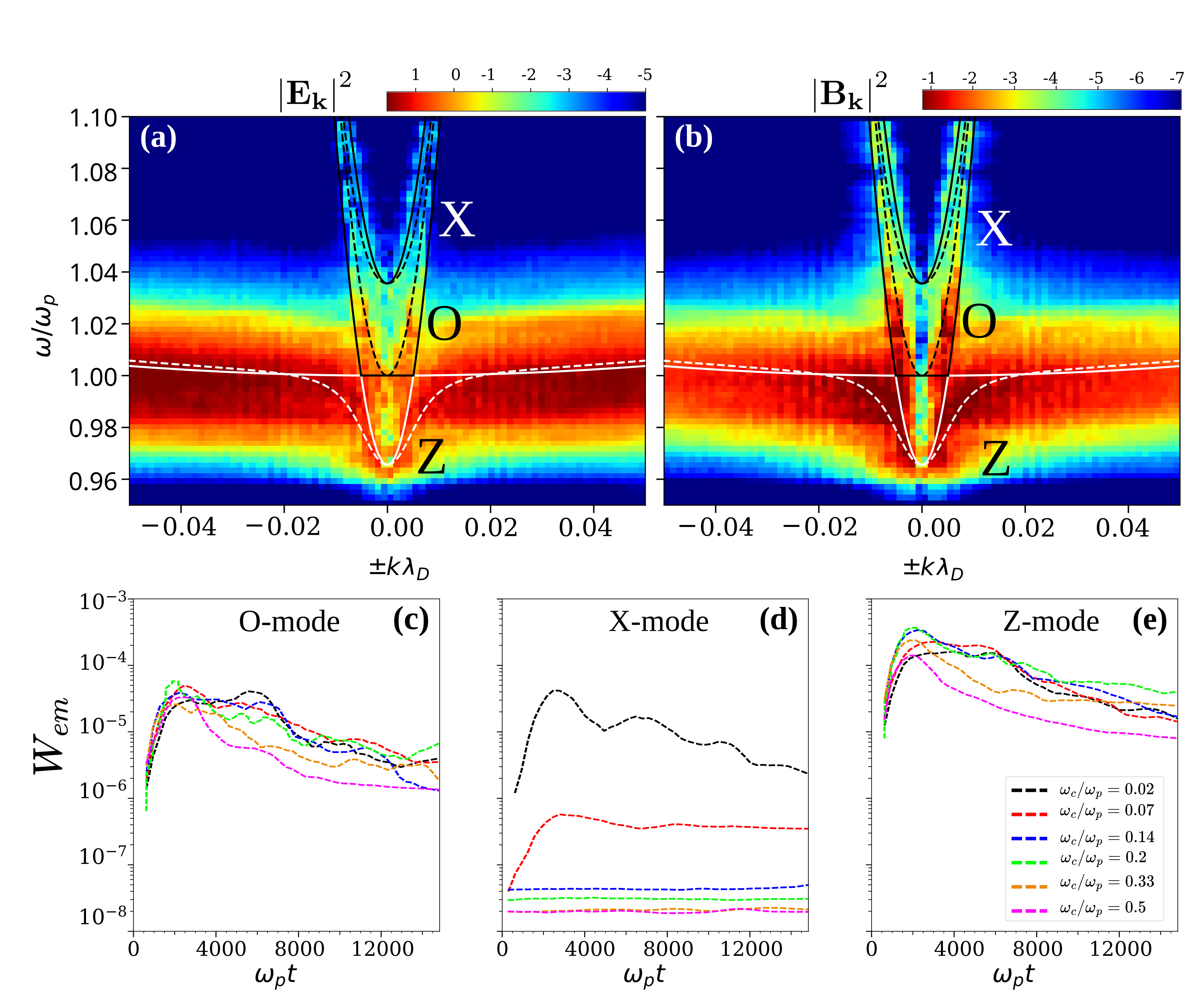
Figure 2 : (a-b) Dispersion of the electric (left) and magnetic (right) spectral energies of the waves (normalized frequency versus normalized wavevector modulus). The theoretical curves calculated using the magnetoionic theory are superimposed (black and white lines), together with labels indicating the electromagnetic modes O, X and Z. (c-d) Variations of the electromagnetic energy radiated in each mode as a function of normalized time, for different values of plasma magnetization ratio ωc/ ωp (see legend in (e)).