





Sophie Bravo successfully defended her PhD thesis on plasma-assisted CO₂ hydrogenation using water as the hydrogen source
20 Nov. 2026
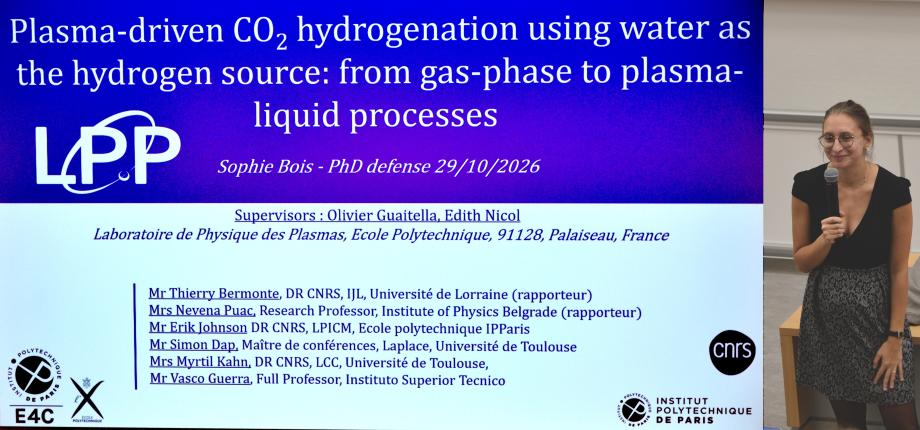
- Congratulations to Sophie Bravo who succesfully defended her thesis entitled "Hydrogénation du CO2 assistée par plasma avec l’eau comme source d’hydrogène : des procédés en phase gazeuse aux procédés plasma-liquide".
- Abstract
To combat global warming, CO2 recycling is one of the major challenges of our time. Technological solutions, that use CO2 as a feedstock are beginning to emerge, however they use H2 as a reactant. Securing an H2 source that is sufficiently cheap to be economically viable remains however a challenge today. Water being the most abundant source of hydrogen on earth, direct CO2 hydrogenation with water would be an ideal recycling process.
- A few articles have reported the detection of oxyagenated organic molecules when a CO2 non-thermal plasma is generated in contact with liquid water. Non-thermal plasmas, are partially ionized gas that are out of thermodynamic equilibrium. The objective of this thesis is to assess the feasibility of the production of oxygenated organic molecules using liquid H2O as a hydrogen source in CO2 non-thermal plasmas.
- Several independent setups were employed: the gas-phase chemical kinetics (studied at low pressure), the study of streamers and DC glow discharge in a CO2 atmosphere above a liquid surface. The kinetics of low pressure discharges in CO2/H2 and CO2/H2O mixtures was studied by systematic comparison between experiments and a 0D simulation. A low pressure DC glow discharge was used as a benchmark to validate the electron and chemical kinetics in these gas mixtures, whereas a pulsed RF discharge in a batch reactor was used to set temporal constraints on the chemical processes. CO+OH → CO2+H was found to be responsible for a drop in the CO2 dissociation fraction and its reaction rate could be constrained by systematic comparison between experiment and simulation.
- Production of oxalate, formate and acetate in the liquid phase was evidenced for an atmospheric pressure DC glow and streamer discharges in CO2 in interaction with liquid water. Initial conclusions point towards the importance of the reaction between solvated electrons and dissolved CO2 regarding oxalate production. Regarding formate production, results mostly point towards the contribution of the gas phase chemistry, where formate precursors could be generated in the plasma before solvating into the liquid, the liquid acting then as a protective barrier on the produced formates.
- Date and venue of the Defense
- Date: Thursday 29th of October 2026, 1:30 pm
- Location: Amphithéâtre Faure, Ecole Polytechnique.
- Examination Committee
- Erik Johnson: CNRS Research Director, École Polytechnique, LPICM, France - Chair
- Thierry Belmonte: CNRS Research Director, University of Lorraine, IJL, France - Reviewer
- Nevena Puač: Research Professor, Institute of Physics Belgrade, Serbia - Reviewer
- Simon Dap: Associate Professor, University of Toulouse, LAPLACE, France - Examiner
- Myrtil Kahn: CNRS Research Director, University of Toulouse, LCC, France - Examiner
- Vasco Guerra: Associate Professor, Instituto Superior Técnico, Portugal - Examiner
- Edith Nicol: Research Engineer, École Polytechnique, LCM, France - Thesis Co-supervisor
- Olivier Guaitella: Research Engineer, École Polytechnique, LPP, France: Thesis Supervisor