





Validation of actinometry techniques by benchmarking against CRDS and E-field probes in an O2 glow discharge
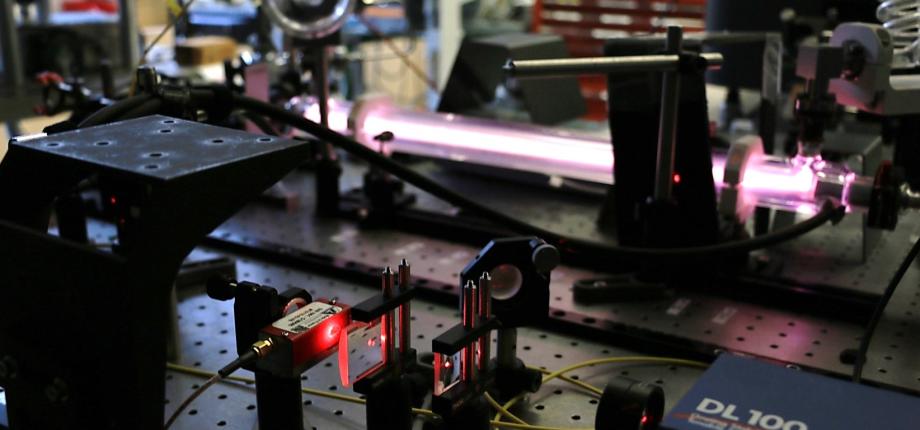
Measurements of absolute atomic oxygen density and reduced electric field are crucial for the understanding and development of plasma-based technologies. Probing them, however, usually requires active methods that are either perturbative or highly costly and complex. Optical emission spectroscopy (OES) is widely used as it is passive and uses simple equipment. However, extracting reliable quantitative results is difficult. The commonly-used “Actinometry” technique addresses this by admixing trace rare gases (called actinometers), and using the ratio of emission line intensities coupled with a collisional radiative model of electron-impact excitation and (radiative and collisional) de-excitation. However, these models are heavily dependent on input data, including electron impact excitation cross sections and quenching coefficients. Unfortunately, these data are often either entirely absent from the literature, or vary greatly, resulting in high uncertainty in actinometric results.
We have critically evaluated OES line-ratio techniques for the determination of absolute oxygen atom fraction and reduced electric field in an O2 glow discharge with traces of argon and xenon. The EEDF and electron impact excitation rates were calculated using the LisbOn KInetics Boltzmann solver (LOKI-B). We compare the results obtained with various data sets available in the literature. The results are benchmarked by simultaneous direct measurements of atomic oxygen density and gas temperature (using single-mode laser CRDS at 630nm), and of the electric field (by floating electrostatic probes). This approach allows us to put major constraints on the input data and validate further use. The best agreement was obtained using the cross sections from the BSR500 database, but with the Ar (750nm) excitation cross-section increased by a factor of 3±0.5.
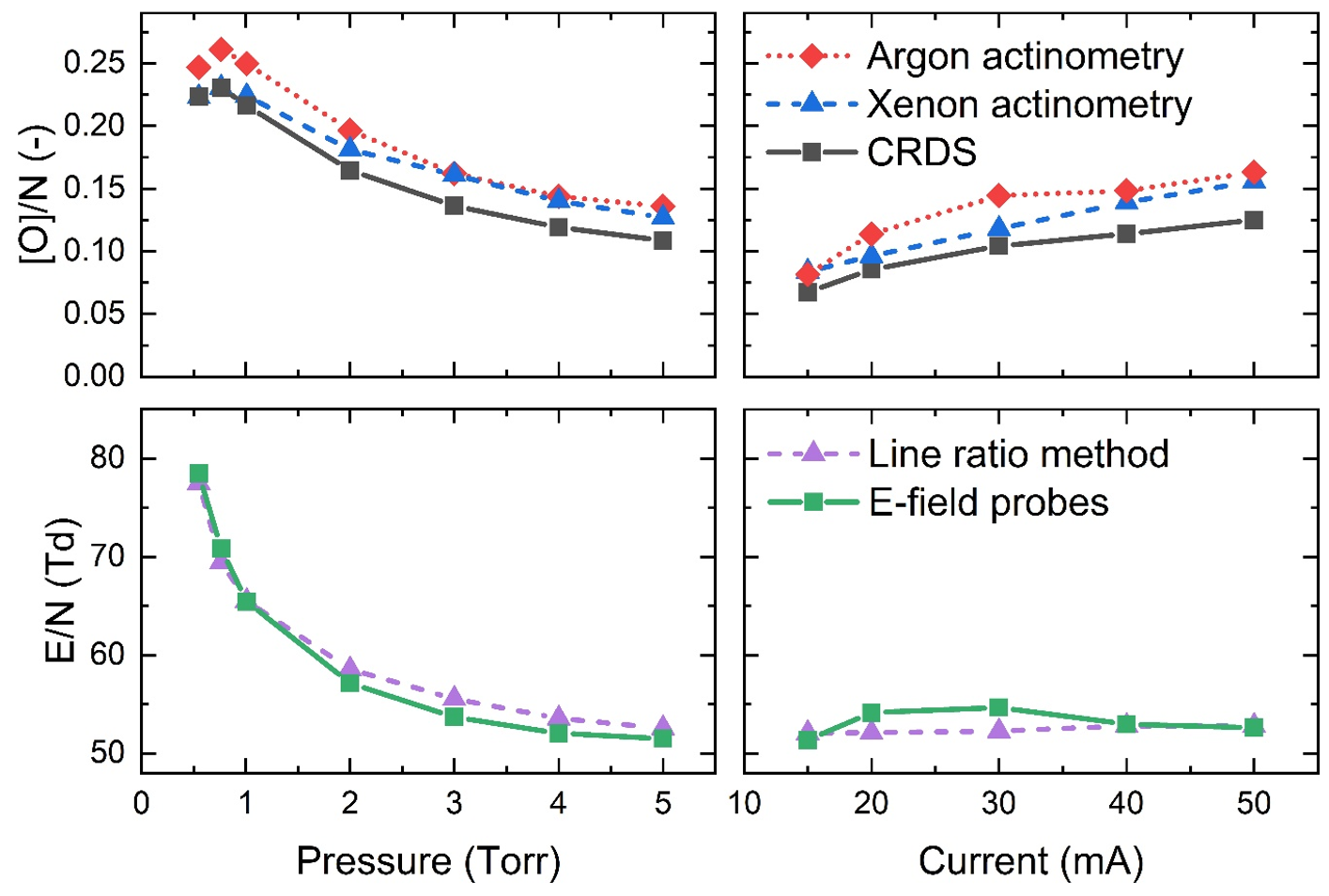
Comparison of the atomic oxygen fraction and reduced electric field determined by line ratio methods to direct (CRDS and electric probe) measurements, in an O2 glow discharge with 5% argon and 2% xenon. Pressure variation (left) at 40 mA and current variation (right) at 5 Torr.
- The work is presented in two parts:
- Atomic oxygen density (actinometry, part I)
- Reduced electric field (line ratio method, part II)
- Contacts:
- Olivier Guaitella, LPP
- Lex Kuijpers, DIFFER
- Source : Plasma Sources Sci. Technol. 35, 2026
- Part I : 015009 (https://doi.org/10.1088/1361-6595/ae24a9)
- Part II : 015010 (https://doi.org/10.1088/1361-6595/ae24aa)