





Ambre Ghisalberti successfully defended her PhD thesis on the statistical study of the location of magnetic reconnection at the magnetopause
06 Oct. 2026
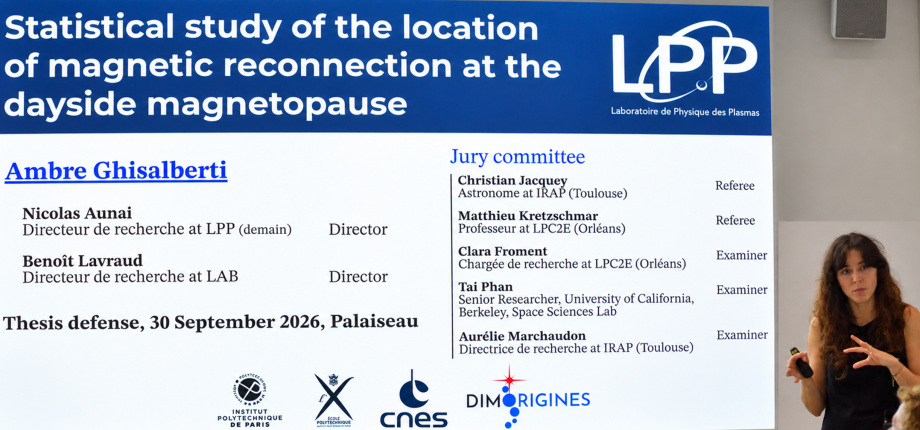
Congratulations to Ambre Ghisalberti, who successfully defended her PhD thesis entitled “Statistical Study of the Location of Magnetic Reconnection at the Magnetopause.”
- Abstract
- Magnetic reconnection constitutes the primary coupling mechanism between the Earth's magnetosphere and the solar wind, driving the formation of the boundary layer between these two plasmas. The efficiency of this phenomenon depends heavily on the position of the X-line, where reconnection occurs. Due to its inherent multi-scale nature, the location of reconnection—and its variability in response to interplanetary properties—remains poorly understood to date. While several models predict the location of reconnection, their validation remains either fragmentary when relying on localized satellite measurements, or dependent on global magnetohydrodynamics numerical simulations that are computationally expensive and not necessarily realistic. The primary obstacle before this PhD lied in the inability to directly map the magnetopause on a global scale using only in-situ data.
- This thesis provides new observational constraints to the X-line position. Our methodology relies on the fact that reconnection strongly alters the, otherwise axisymmetric, plasma flow around the magnetopause, by accelerating plasma away from the X-line. The work of this PhD starts with the conception and implementation of a innovative method based on statistical learning to automatically extract and process all boundary layer crossings recorded over two decades by the multi-satellite missions Cluster, THEMIS, and MMS. By reconstructing a global map of the flow on the dayside magnetopause allows us to locate the X-line at the source of the diverging plasma flows, characterizing its dependence on the interplanetary magnetic field direction and the Earth dipole tilt.
- Finally, a systematic comparison between various model predictions, global MHD simulation results, and our empirical observations allows us to better discern the physical mechanisms governing the localization of magnetic reconnection. Our results seem to indicate that the X-line is spontaneously located in a way to maximize the reconnection rate. We critically examine our methodological limits and technical constraints to properly nuance the scope of our results.
- Date & Venue of the defense
- Wednesday, September 30, 2026, at 1:30 p.m.
- Lecture Hall 10-02 – BEM Building, École Polytechnique, Palaiseau
- Examination Committee
- Aurélie Marchaudon, Research Director, Institute for Research in Astrophysics and Planetology (IRAP): Chair of the Committee
- Christian Jacquey, Astronomer, Institute for Research in Astrophysics and Planetology (IRAP): Referee
- Matthieu Kretzschmar, Professor, Laboratory of Physics and Chemistry of the Environment and Space (LPC2E): Referee
- Clara Froment, Research Scientist, Laboratory of Physics and Chemistry of the Environment and Space (LPC2E): Examiner
- Tai Phan, Senior Researcher, University of California, Berkeley, Space Sciences Laboratory: Examiner
- Nicolas Aunai, Research Director, Laboratory of Plasma Physics (LPP): PhD Supervisor
- Benoît Lavraud, Research Director, Bordeaux Astrophysics Laboratory (LAB): PhD Supervisor