





Gwendal Hénaff, i-PhD 2026 laureate and Grand Prix Souveraineté winner for 3DCAM Sensors
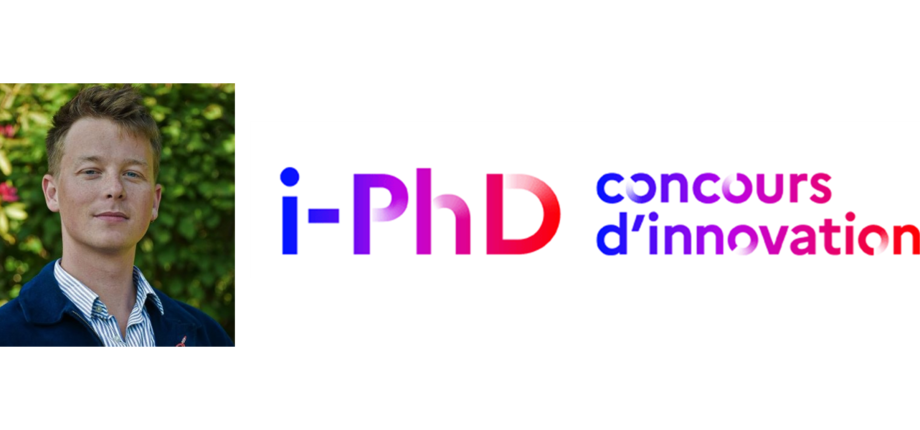
Gwendal Hénaff, who completed his PhD at the Laboratoire de Physique des Plasmas (LPP), is a 2026 i-PhD laureate with his 3DCAM Sensors project. He also received the Grand Prix Souveraineté, recognizing the strategic potential of a technology developed at the LPP to improve the characterization of the space environment.
Gwendal Hénaff defended his PhD at the LPP in 2024 under the supervision of Matthieu Berthomier, CNRS researcher at the LPP. His work led to the development of 3DCAM, a miniaturized plasma camera designed to measure charged particles in space. In particular, the instrument can determine the density, energy and direction of electrons and ions.
With 3DCAM Sensors, the aim is now to bring this technology closer to operational applications, particularly in the field of space weather. Solar events can accelerate charged particles that may disrupt satellites and certain technological infrastructures. However, these phenomena remain difficult to predict, notably because of the lack of sufficiently precise data to feed forecasting models.
3DCAM Sensors therefore aims to develop and industrialize compact sensors capable of measuring the low-Earth-orbit particle environment in real time. In the longer term, these observations could help improve warning systems and enable satellite operators to better anticipate the consequences of major solar events.
The development of 3DCAM relies on several innovations developed during Gwendal Hénaff’s PhD, including a new optical architecture made possible by additive manufacturing, a selective metallization process, and miniaturized detection electronics developed at the LPP.
The project also benefits from the test facilities installed at the LPP on the Jussieu campus, which make it possible to characterize and calibrate instruments under vacuum, under controlled electron and ion fluxes, and in a controlled environment.
Gwendal Hénaff is now working with a team of engineers specializing in electronics and mechanics to develop a flight model. 3DCAM has been selected by CNES for a demonstration flight scheduled for 2028, an important step toward validating the technology under real space conditions.
This double distinction, 2026 i-PhD laureate and Grand Prix Souveraineté winner, marks a new stage in the transition of a technology originating from research at the LPP toward an industrial project serving the needs of space weather.