





Smile: a new space mission to observe Earth’s magnetic shield
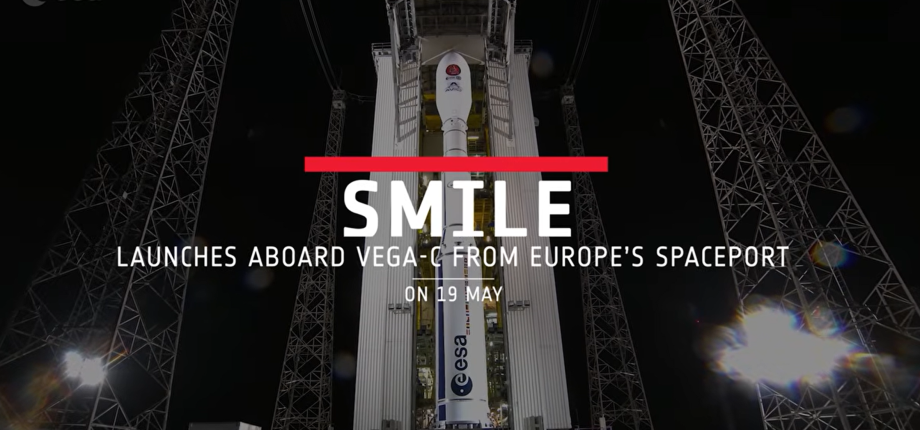
The Smile space mission was successfully launched on 19 May 2026 aboard a Vega-C rocket from Europe’s Spaceport in Kourou, French Guiana. Jointly led by the European Space Agency and the Chinese Academy of Sciences, Smile (Solar wind Magnetosphere Ionosphere Link Explorer) opens a new chapter in the study of interactions between the Sun and Earth’s magnetic environment. LPP contributes to this scientific endeavour through the involvement of the Particles team led by Matthieu Berthomier in the LIA instrument, dedicated to analysing ions in the solar wind and magnetosheath.
Earth is surrounded by a vast magnetic bubble, the magnetosphere, which largely protects it from the charged particles continuously emitted by the Sun. When the solar wind intensifies, it can disturb this environment, trigger polar auroras, affect satellites, and disrupt certain technological infrastructures. Understanding how energy from the solar wind is transferred, transported and then dissipated within the magnetosphere is therefore a major challenge for space physics and for predicting the effects of space weather.
The originality of Smile lies in its ability to combine, within a single mission, global observations and local measurements. The mission will observe Earth’s magnetosphere in X-rays and the auroras in ultraviolet light, in order to monitor, on a large scale, how Earth’s environment responds to variations in the solar wind. At the same time, onboard instruments will carry out in situ measurements of the plasma encountered by the spacecraft.
It is in this context that LPP’s contribution takes place, through the involvement of the Particles team, led by Matthieu Berthomier, in the LIA (Light Ion Analyzer) instrument. This ion analyser will measure the three-dimensional distributions of ions in the solar wind and magnetosheath. It will provide essential plasma parameters such as ion density, velocity, temperature and distribution.
These measurements will make it possible to characterise the forcing exerted by the solar wind on Earth’s magnetosphere. They will also be essential for interpreting the global images obtained by Smile’s X-ray and UV instruments, by linking large-scale observations to local plasma conditions. LPP’s contribution is therefore at the heart of the mission’s scientific approach, which relies on combining global imaging with in situ measurements.
This strategy should help identify more precisely the regions where energy from the solar wind is transferred and then dissipated in Earth’s environment. Smile data will contribute to improving models of the magnetosphere and to gaining a better understanding of the physical processes behind geomagnetic storms.
With Smile, LPP continues its involvement in major international space missions dedicated to plasma physics. This contribution highlights the laboratory’s expertise in the study of the solar wind, space plasmas and onboard instrumentation, in support of a deeper understanding of the connection between the Sun and Earth.
Link to the article "The Light Ion Analyzer (LIA) for the SMILE Mission": click here