





Climate group

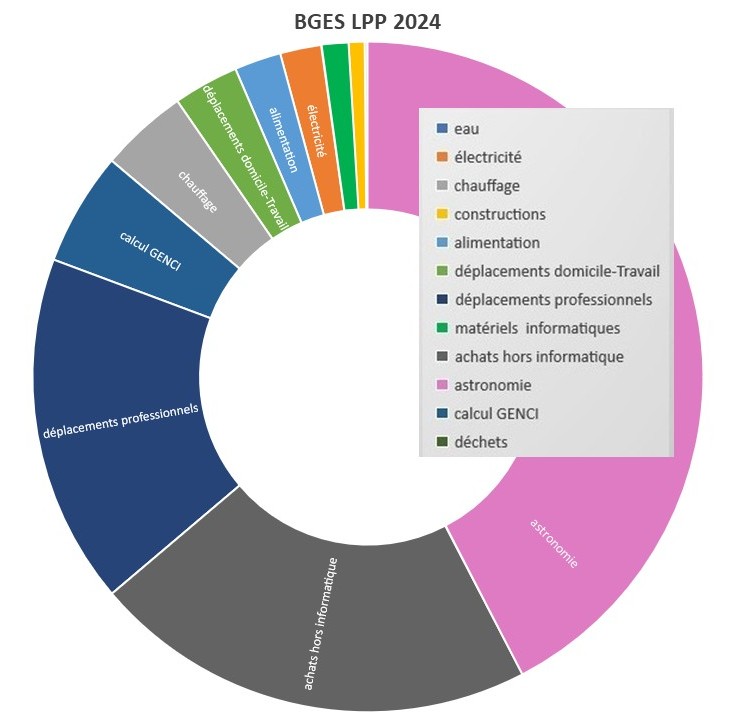
At the initiative of around ten staff members, an LPP Climate Group was created during the Laboratory Council meeting of April 2, 2021. Each year, this group analyzes the environmental footprint of the LPP’s research activities and proposes measures to reduce it to the Laboratory Council. It also raises requests and recommendations to our supervisory institutions. The most recent assessment conducted covers the year 2024. Detailed results are available on the Labo1point5 platform.
Since December 2024, the LPP has been recognized as a “Laboratory in transition”.
For France, the objectives of the Paris Agreement aim to reduce greenhouse gas emissions by 40% by 2030 compared to 1990 levels. Concretely, this means reducing emissions from 9.5 t CO₂e* per person per year in 1990 to 5.7 t CO₂e within less than ten years.
By 2050, in order to limit global warming to +2°C by 2100, emissions will need to fall to 2 t CO₂e per person per year.
* Ton of CO₂ equivalent (CO₂e): the amount of CO₂ that would have the same global warming potential as a given quantity of another greenhouse gas emitted. In other words, all greenhouse gases are expressed in terms of their equivalent in carbon dioxide.
Emissions related to our buildings: construction, heating, water consumption, electricity use.
Emissions related to commuting: a daily 20 km commute by a gasoline car represents about 1 t CO₂e per year. The same trip by electric bicycle reduces annual emissions tenfold, to about 0.1 t CO₂e.
Emissions related to business travel:
A round-trip flight Paris–New York emits about 1.7 t CO₂e.
Paris–Tokyo round trip emits about 3 t CO₂e.
For a Paris–Toulouse round trip:
0.25 t CO₂e by plane
0.26 t CO₂e by gasoline car
0.0072 t CO₂e by intercity train
0.0024 t CO₂e by high-speed train (TGV)
Emissions related to our research activities: an average €3,000 equipment purchase represents approximately 1 t CO₂e. Research activities carried out outside the laboratory also have an impact. For example, 1 million computing hours on Xeon processors correspond to approximately 4 t CO₂e**.
A meal containing red meat emits 5.5 kg CO2e, which is seven times more than a meal with vegetables only .
* ton of CO2 equivalent
** source : https://hal.archives-ouvertes.fr/hal-02549565v4
Laboratory-level measures: in December 2024, the Laboratory Council approved first-class train travel for any journey longer than four hours.
Assess your travel impact before traveling. Several online tools are available:
ADEME transport carbon calculator
MonPetitCarbone calculator (for professional and commuting travel)
Travel carbon comparison tool developed by IRAP
If you are not convinced about the carbon benefit of trains over planes, you can watch the following videos:
The CO₂ Match: Trains vs. Planes
Trains vs. Planes: The Rematch!
Update your knowledge on emissions: with the help of Le Monde’s “Les Décodeurs,” test whether you can estimate what emits a lot or little CO₂ and evaluate whether your own emissions are truly sustainable. You can also calculate your overall personal carbon footprint:
If you would like to commute by bicycle:
You can use the Geovelo app and join the IPP or Sorbonne Université communities.
Information on bicycle parking in Palaiseau is available here.
Sorbonne Université Sustainable development webpage
Motion adopted by the L'OCEAN laboratory in September 2020
Article published by IRAP on its carbon footprint and its summarized version