





Plasmas for space propulsion

Toward new space propulsion systems
Spacecraft propulsion relies on the same fundamental principle: generating thrust by accelerating and expelling mass. Chemical rockets produce very high thrust by rapidly ejecting large amounts of gas, allowing them to escape Earth’s gravity. However, this method is energy-intensive, inefficient for long-duration missions, and costly in terms of propellant.
In comparison, electric propulsion has emerged as a promising alternative, particularly for interplanetary missions and station-keeping in orbit. Although their thrust is lower, electric thrusters can achieve exhaust velocities on the order of 20 km/s, enabling substantial gains in efficiency and reduced onboard propellant mass. Two technologies are widely used today: gridded ion thrusters (ion engines) and Hall thrusters. They operate by extracting and accelerating ions from a plasma and then neutralizing the ion beam using electrons emitted from a hollow cathode.
Electric propulsion at the LPP
Since 2007, the Laboratory of Plasma Physics (LPP) has been conducting experimental, theoretical, and simulation research in electric propulsion. An initial innovative project, the Neptune gridded thruster, based on RF acceleration inspired by plasma etching processes, led to the creation of the start-up ThrustMe in 2016.
Today, two major research directions structure the LPP’s activities in this field.
The PEGASES project – Plasma propulsion with electronegative gases
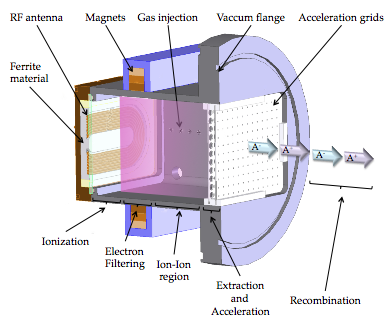
The PEGASES thruster, patented as early as 2007, is based on an original concept: using both positive and negative ions to generate thrust. The system relies on a high-density electronegative plasma, from which electrons are removed using a magnetic field, leaving a so-called ion–ion plasma region composed only of ions.
Thrust is generated by alternately extracting and accelerating positive and negative ions. This method eliminates the need for a neutralizing cathode, simplifying the system and reducing losses.
LPP research has made it possible to optimize magnetic electron filtering, study plasma instabilities, and assess iodine as an alternative propellant.
Hall thrusters and industrial partnership
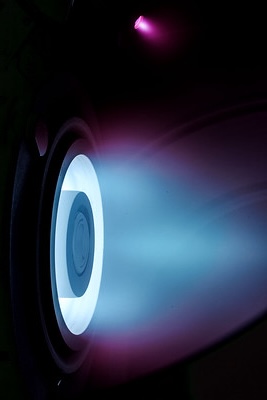
Since 2014, the LPP has also developed recognized expertise in Hall thrusters, initially through a CIFRE PhD collaboration with Safran and later through the ANR industrial chair POSEIDON (2016–2022). This collaboration with Safran Spacecraft Propulsion, CERFACS, and ICARE led to the completion of nine PhD theses (including three CIFRE projects), the publication of 21 articles in international journals, and participation in numerous international conferences.
The results focus on plasma instabilities, anomalous electron transport, and plasma–wall interactions. This work led to the design of a modular prototype thruster optimized for experimental testing and detailed performance analysis.
COMHET – A joint laboratory for the thrusters of tomorrow
In November 2023, the COMHET joint laboratory was inaugurated by the CNRS, École Polytechnique, and Safran Spacecraft Propulsion. This strategic partnership aims to overcome several scientific and technological challenges related to Hall thrusters. It is structured around three main research axes:
Axis 1: Study of alternative propellants (notably iodine, which is more cost-effective than xenon)
Axis 2: Development of advanced numerical simulations
Axis 3: Design of intelligent, non-intrusive diagnostics
The objective of COMHET is to improve the reliability and performance of propulsion systems while reducing the number, duration, and cost of vacuum tests. Through these efforts, the LPP actively contributes to the development of next-generation space thrusters.
More information: click here