





Theory, simulation and numerical experiments
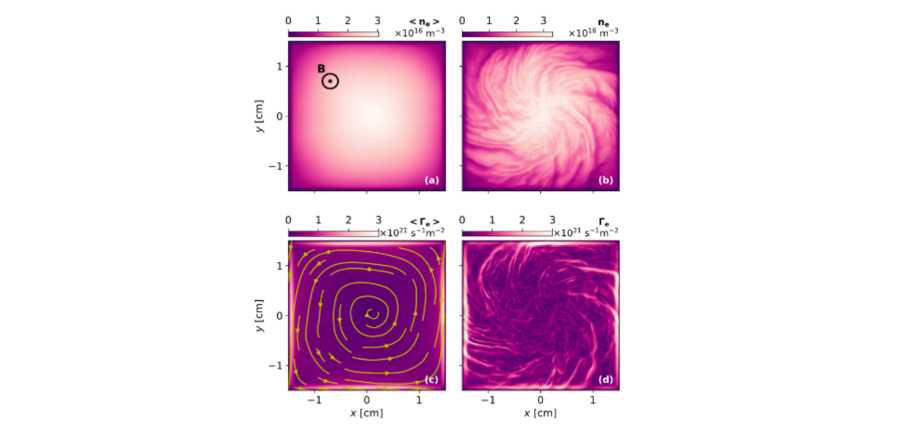
Theory, modeling, and simulations complement experimental studies by providing access to quantities that are difficult or impossible to determine experimentally, and by enabling a deeper understanding of the underlying physics. The validation of the developed codes is carried out both through quantitative comparisons with experiments and through benchmark simulations of reference cases across different codes.
The plasma sources investigated cover a wide range of conditions and are strongly out of equilibrium, making kinetic effects on transport, chemistry, and surface interactions fundamental. Consequently, the modeling work relies on a combination of “fluid” models (based on moments of the Boltzmann equation) and fully kinetic models such as Monte Carlo methods and Particle-In-Cell / Monte Carlo Collisions (PIC/MCC) simulations.
A significant part of the LPP’s modeling activities focuses on the verification and validation of numerical approaches against experiments, enabling a reassessment of the fundamental physics of discharges. In particular, an international benchmark was conducted by the LPP in which seven independently developed PIC codes for a Hall-effect thruster were compared. This comparison made it possible to analyze the convergence of PIC models and ensure the reproducibility of the identified instabilities.
A major and original advancement of these codes is the ability to perform “numerical diagnostics,” by simulating both the plasma and the response that an experimental diagnostic would have to that plasma. This technique has, for example, been used to study a virtual collective Thomson scattering diagnostic applied to PIC data, in order to investigate small-scale phenomena related to anomalous transport and to bridge simulations and experiments.
Furthermore, the physics of atmospheric-pressure plasma jets and their interactions with surfaces have been studied both numerically and experimentally. A comprehensive comparison was presented, including the electric field in the plasma as well as in dielectric surfaces under plasma exposure, the mean electron energy, the electron number density, and the surface charge of the targets. This approach makes it possible to assess the fidelity of the models and to provide perspectives for future improvements in both modeling and experiments.
Another example, this time at low pressure, concerns a theoretical model that was compared with measurements of striations in radio-frequency plasmas, providing a completely new interpretation of these instabilities.
The team’s activities also include theoretical work addressing fundamental issues, such as the development of a macroscopic model capable of capturing kinetic effects in low-temperature discharges. A higher-order fluid model was derived from kinetic theory, enabling closure terms with few collisions and efficient modeling of non-local transport effects. Likewise, efforts to derive new numerical schemes based on advanced numerical analysis have been pursued, leading to more efficient numerical simulations.