





Reference plasma sources & New spatio-temporal frontiers
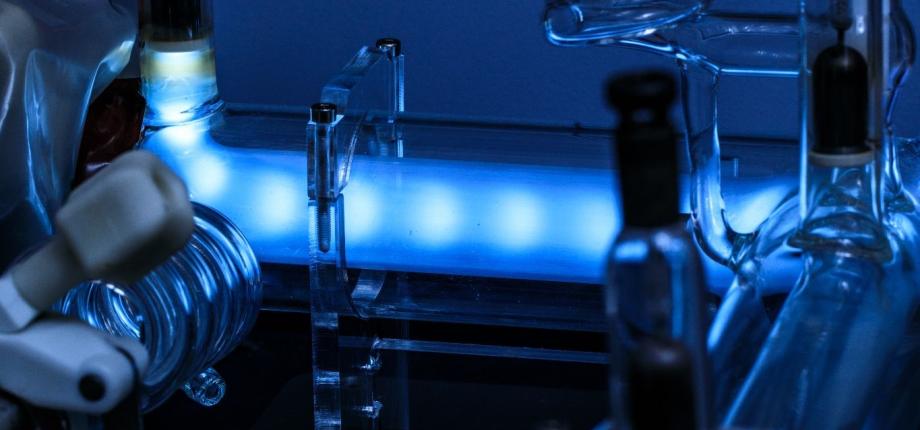
The need to develop reference systems
To fully exploit the specific features of cold plasmas, it is essential to understand their basic mechanisms, which requires studying simpler model systems providing access to collision or spectroscopic data essential for better understanding. Modeling cold plasmas requires atomic or molecular data whose values reported in the literature often suffer from large uncertainties or even complete absence.
An original approach of the team consists in designing model discharges whose geometries, plasma-facing materials, and excitation voltage waveforms are conceived to allow (i) the use of numerous complementary diagnostics to best characterize plasma parameters and (ii) relatively straightforward quantitative comparison with numerical models.
These model plasma sources are often glow discharges at a few mbar, but may also include RF cells with external electrodes or coaxial plasma jets at higher pressure. Thanks to systematic coupling of experiments and quantitative numerical simulations, data such as the electron-impact dissociation cross-section of CO₂ or the relative contributions of thermal versus electron-impact dissociation of I₂ have been obtained.
Beyond electronic and chemical kinetics schemes, fluid, PIC, or hybrid models developed in axis (iv) can also be tested and validated through these benchmark cases.
These model plasma cells are also powerful tools for spectroscopic studies. For example:
Two-photon absorption cross-sections of xenon were measured for absolute calibration of atomic oxygen densities.
An analytical formula was established to select energy levels minimally broadened by hyperfine structure for accurate temperature measurements.
The TALIF technique applied to iodine atoms led to temperature measurements and revision of iodine atomic energy levels as tabulated by the National Institute of Standards and Technology.
Validation efforts extend beyond low pressure. Highly reproducible ionization wave sources have been developed in capillaries with nanosecond pulses around 100 mbar in molecular gases, or at atmospheric pressure in helium with kHz coaxial plasma jets. These sources enabled the first quantitative comparisons of electric fields induced by ionization waves on dielectric surfaces, measured experimentally by Mueller polarimetry and numerically by fluid streamer models.
Spatial and temporal limits in cold plasmas
Over the past 20 years, a strong trend in the cold plasma community has been the increase in studies of high-pressure plasmas (>100 mbar), with emblematic applications such as plasma-assisted combustion, air treatment, CO₂ valorization, biomedical and agricultural applications, and nanomaterial synthesis.
Strong electric field gradients, charge density variations, and gas composition gradients evolving on nanosecond time scales require original methods to understand the mechanisms. The team studies three main topics:
(a) nanosecond discharge dynamics
(b) interaction of filamentary discharges with complex dielectric surfaces (catalysts, semiconductors, biological tissues, etc.)
(c) interaction with a liquid phase
Nanosecond discharges, generated with voltage pulses up to several hundred kilovolts and rise times of a few nanoseconds, allow maintenance of high electric fields and electron densities for tens of nanoseconds, from mbar to atmospheric pressure. They enable efficient dissociation via excited molecules, triggering strongly non-equilibrium chemistry. They serve as excellent model systems for high-field plasma kinetics and advanced diagnostics.
Applications include:
generation of weak shock waves for aerodynamic actuators,
uniform production of active species for medical applications,
controlled heat and radical production up to 30 bar for plasma-assisted combustion,
material treatment and nanoparticle production.
Surface interaction studies rely strongly on the development of new time-resolved in situ surface diagnostics, such as Mueller polarimetry under plasma exposure, in situ infrared absorption for plasma–catalyst coupling, Raman diagnostics, and plasma–liquid interface studies.